

Faith nonprofits face an urgent challenge in 2026: while AI adoption has surged 80% in church operations, 73% of ministry leaders still lack formal policies to guide these tools. This gap creates confusion around digital engagement and its role in modern ministry. Digital engagement involves more than posting on social media or sending emails. It represents a comprehensive approach to building authentic relationships with your community through online platforms, and AI now plays a central role in making these connections scalable and personalized. This guide clarifies what digital engagement truly means for faith-based organizations and how AI can amplify your outreach without compromising your mission.
Table of Contents
- Understanding digital engagement in faith nonprofits
- How AI is transforming digital engagement in churches
- Balancing AI benefits with theological and ethical considerations
- Practical strategies for effective AI-powered digital engagement
- Measuring and maximizing impact through digital engagement
- Boost your faith nonprofit's outreach with AI-powered digital marketing
- Frequently asked questions
Key takeaways
| Point | Details |
|---|---|
| Digital engagement builds relationships | Using websites, social media, email, and apps to connect meaningfully with communities and donors online |
| AI adoption lacks governance | 91% of church leaders welcome AI tools but 73% operate without formal policies or ethical guidelines |
| Communication remains top priority | 51% of ministry leaders cite improving communication as their primary operational challenge |
| Automation drives donation growth | Marketing automation can increase nonprofit donations by 33% through personalized, timely outreach |
| Balance technology with theology | AI must complement human ministry, not replace prayerful insight and authentic spiritual connection |
Understanding digital engagement in faith nonprofits
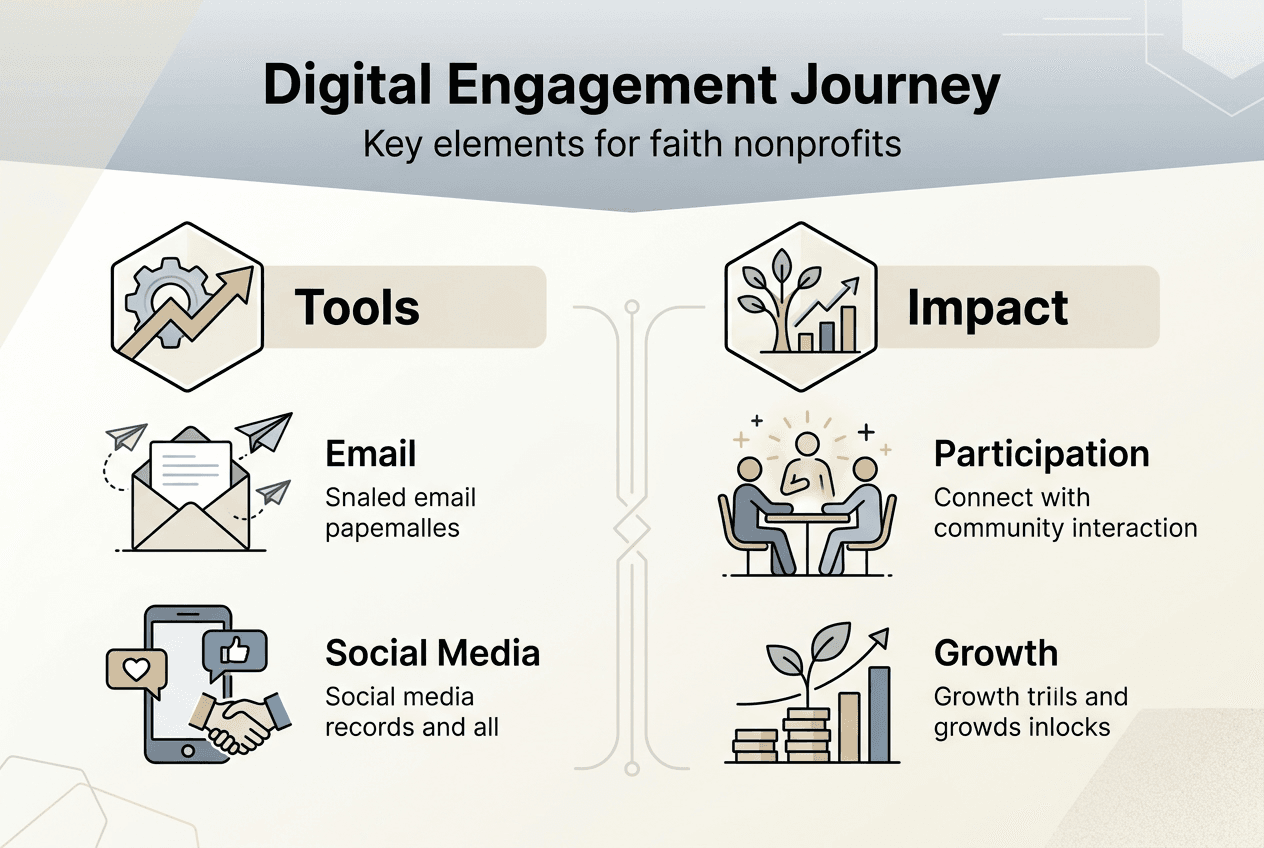
Digital engagement represents the ongoing process of connecting with your community through online channels to build meaningful relationships that support your ministry mission. For faith-based nonprofits, this means using websites, social media platforms, email campaigns, and mobile apps to reach both active members and spiritual seekers beyond your physical location.
The importance of effective digital engagement becomes clear when you consider that communication tops the challenge list for 51% of ministry leaders. Your congregation and donors expect timely updates, personalized messages, and convenient ways to participate in your mission. Digital platforms provide these connection points when physical gatherings cannot.
Effective digital engagement addresses several critical ministry needs:
- Maintaining connection with members between services and events
- Reaching new audiences who discover your ministry online first
- Providing convenient giving options that align with donor preferences
- Sharing your message and impact stories across broader geographic areas
- Creating interactive experiences that deepen spiritual formation
The shift toward digital ministry accelerated dramatically in recent years, making these capabilities essential rather than optional. Organizations that master nonprofit digital marketing strategies report stronger community bonds and increased financial support. Your digital presence now serves as the first impression for most people exploring your ministry, making engagement quality critical to growth.
Digital engagement differs from simple broadcasting. Broadcasting pushes information out without expecting response or interaction. True engagement invites dialogue, encourages participation, and adapts based on how your audience responds. This two-way communication builds trust and demonstrates that you value each person's spiritual journey.
How AI is transforming digital engagement in churches
Artificial intelligence has rapidly reshaped how faith organizations approach digital communication, with AI use jumping to 45% of church operations in 2026. This 80% increase from the previous year reflects growing recognition that AI tools can handle repetitive tasks while freeing ministry leaders to focus on pastoral care and spiritual guidance.
Churches currently deploy AI across several key functions:
- Automated email sequences that welcome new visitors and nurture spiritual growth
- Social media scheduling tools that maintain consistent online presence
- Chatbots answering common questions about service times and ministry programs
- Personalized content recommendations based on individual interests and engagement history
- Predictive analytics identifying members who may need pastoral outreach
Despite widespread adoption, a concerning gap exists between implementation and governance. While 91% of church leaders welcome AI, 73% operate without formal policies guiding its use. This policy vacuum creates risks around theological alignment, data privacy, and maintaining authentic human connection.
Many ministry leaders worry that AI might replace the human touch essential to spiritual community. These concerns hold validity, as automated systems cannot pray, discern spiritual needs, or provide genuine empathy during crisis moments. The technology excels at efficiency but lacks the wisdom and compassion that define effective ministry.

Understanding why to use AI in nonprofits requires recognizing both capabilities and limitations. AI handles high-volume communication tasks, analyzes engagement patterns, and personalizes outreach at scale. However, it cannot replace the pastor's counsel, the prayer team's intercession, or the authentic relationships that form the foundation of spiritual community.
Pro Tip: Develop a clear AI policy before expanding your technology stack. Involve ministry leaders, IT staff, and congregational representatives to ensure tools align with your theological values and build rather than erode trust with your community.
The transformation AI brings to digital engagement proves most effective when viewed as augmentation rather than replacement. Technology handles routine tasks while humans focus on high-value interactions requiring spiritual discernment and personal care.
Balancing AI benefits with theological and ethical considerations
The integration of AI into faith contexts raises profound questions about technology's role in spiritual formation and community building. AI scored just 48 out of 100 on understanding core faith dimensions, revealing significant gaps in how these systems comprehend theological concepts central to ministry.
AI systems can generate text that appears theologically sound without actually believing, worshiping, or experiencing spiritual transformation. This fundamental limitation means automated content requires careful human review to ensure doctrinal accuracy and spiritual depth. A prayer written by AI might use correct religious language while missing the heart of genuine communion with God.
Three critical ethical considerations demand attention when implementing AI in ministry contexts:
- Theological alignment ensuring AI outputs reflect your denomination's beliefs and values
- Protecting authentic human interaction from being displaced by efficient but hollow automation
- Data governance preventing misuse of sensitive congregant information
The privacy dimension carries particular weight in faith settings where people share deeply personal struggles, prayer requests, and spiritual questions. Research warns that data collected might be repurposed beyond its original intent, potentially exposing vulnerable individuals or violating trust relationships fundamental to ministry.
Consider how AI processes a prayer request submitted through your website. The system might categorize it, route it to appropriate ministry teams, and track follow-up actions. But what happens to that data long term? Could it train algorithms or be accessed by third parties? These questions require clear policies protecting congregant privacy.
Another concern involves AI potentially amplifying existing biases present in training data. If an AI system learned from predominantly Western theological texts, it might struggle to serve diverse cultural expressions of faith within your community. This limitation underscores the need for human oversight ensuring technology serves rather than shapes your ministry approach.
The role of AI in marketing extends beyond simple automation to influence how you understand and engage your community. This power demands careful stewardship, ensuring technology enhances rather than replaces the relational foundation of effective ministry. Your congregation should experience AI as a helpful tool managed by caring humans, not as an impersonal system driving their spiritual experience.
Balancing these considerations requires ongoing dialogue between ministry leaders, technology experts, and community members. The goal is not rejecting AI but implementing it thoughtfully within a framework that honors both technological capability and theological conviction.
Practical strategies for effective AI-powered digital engagement
Implementing AI tools effectively requires understanding which technologies best serve specific ministry needs while maintaining human oversight. Churches primarily use AI to improve communication efficiency, with 40% focusing automation efforts on this core function.
| AI Tool Type | Primary Use | Ministry Application |
|---|---|---|
| Email Automation | Scheduled campaigns | Welcome sequences, event reminders, donation appeals |
| Social Media Schedulers | Content distribution | Consistent posting, multi-platform management |
| Chatbots | Instant responses | Service times, directions, basic questions |
| Analytics Platforms | Data insights | Engagement tracking, donor patterns, content performance |
| Content Generators | Draft creation | Newsletter ideas, social posts, study guides |
Successful digital engagement combines these tools strategically:
- Segment your email list based on engagement level, giving history, and ministry interests to deliver personalized content
- Schedule social media posts during peak engagement windows while reserving real-time responses for human staff
- Deploy chatbots for common questions but route complex spiritual inquiries to pastoral team members
- Use analytics to identify which content resonates most and adjust your strategy accordingly
- Generate content drafts with AI but always have ministry leaders review and refine before publishing
The benefits of digital marketing automation become tangible when you maintain theological oversight throughout the process. Involve pastors and ministry leaders in reviewing automated content before it reaches your community. This human layer ensures messages reflect your values and speak with authentic spiritual authority.
Consider a practical example: Your church wants to follow up with first-time visitors. An AI system can automatically send a welcome email, provide information about upcoming events, and invite them to connect with a small group. However, a staff member should personally reach out within 48 hours to offer genuine hospitality and answer specific questions. This blend leverages AI efficiency while preserving human warmth.
Pro Tip: Start small with one or two AI tools rather than overhauling your entire digital strategy at once. Master email automation or social scheduling first, measure results, then expand to additional technologies as your team builds confidence and expertise.
The most effective implementations view AI as a ministry multiplier rather than a staff replacement. Technology handles repetitive tasks, freeing your team to focus on relationship building, pastoral care, and spiritual leadership that require uniquely human capabilities.
Measuring and maximizing impact through digital engagement
Tracking the right metrics transforms digital engagement from guesswork into strategic ministry growth. Organizations that measure systematically can demonstrate impact to donors, refine their approach based on evidence, and allocate resources to highest-value activities.
| Metric Category | Key Indicators | Target Benchmarks |
|---|---|---|
| Engagement Rate | Email opens, social interactions | 20-30% email open rate, 3-5% social engagement |
| Conversion | Website visitors to donors | 2-5% conversion on donation pages |
| Growth | List size, follower count | 10-15% annual growth in engaged audience |
| Retention | Repeat donors, active members | 60-70% donor retention year over year |
Research demonstrates that marketing automation increases donations by 33% when implemented strategically. This significant lift comes from personalized timing, relevant messaging, and consistent follow-up that manual processes struggle to maintain.
Maximizing your digital engagement impact requires four systematic steps:
- Define clear goals aligned with ministry priorities, whether increasing service attendance, growing small group participation, or boosting monthly giving
- Monitor key engagement metrics weekly to identify trends and spot issues before they become serious problems
- Adjust messaging and channel mix based on performance data, doubling down on what works while cutting ineffective tactics
- Leverage AI reporting tools for insights that would take hours to compile manually, freeing time for strategic thinking
A/B testing provides powerful insights into what resonates with your community. Test email subject lines, social media post formats, donation page layouts, and call-to-action buttons. Even small improvements compound over time into significant impact gains.
Regular review cycles keep your strategy fresh and responsive. Monthly team meetings should examine performance data, celebrate wins, diagnose struggles, and adjust tactics for the coming period. This rhythm prevents stagnation while building organizational learning.
The connection between measurement and digital outreach impact becomes clear when you track long-term trends. You might discover that video content generates triple the engagement of text posts, or that Tuesday morning emails outperform Friday afternoon sends. These insights guide resource allocation toward highest-impact activities.
Remember that metrics serve ministry rather than defining it. Numbers reveal patterns and opportunities but cannot capture the full spiritual impact of your work. Balance quantitative analysis with qualitative feedback from community members about how digital engagement supports their faith journey.
Boost your faith nonprofit's outreach with AI-powered digital marketing
Navigating the intersection of technology and ministry requires expertise in both digital strategy and faith-based organizational dynamics. MCNM Marketing specializes in helping nonprofits and ministries implement AI-powered solutions that amplify mission impact while honoring theological convictions.
Our team understands the unique challenges faith organizations face when adopting digital tools. We provide marketing automation solutions proven to increase donations by 33%, along with website design services optimized for ministry contexts. Whether you need to establish your first digital presence or scale existing outreach efforts, we offer tailored strategies that align technology with your mission.
Partner with specialists who recognize that effective digital engagement serves spiritual formation rather than replacing it. Our approach combines cutting-edge AI capabilities with deep respect for the human relationships central to ministry success. Explore how digital outreach strategies can expand your kingdom impact while staying true to your calling.
Frequently asked questions
What are the common challenges faith nonprofits face with digital engagement?
Communication effectiveness tops the list, with 51% of ministry leaders identifying it as their primary operational challenge. Many organizations struggle to balance technological efficiency with authentic spiritual connection. Additional hurdles include limited technical expertise, budget constraints, and concerns about theological alignment when using automated tools.
How can AI improve communication with congregation members?
AI automates routine messaging like event reminders and welcome emails, personalizes content based on individual interests, and schedules social media posts for consistent presence. These efficiencies free staff to focus on pastoral care requiring human wisdom. However, ministry leaders must review AI-generated content to ensure messages reflect core values and spiritual depth.
What ethical concerns should leaders consider when adopting AI?
Prioritize preventing AI from replacing authentic human interaction essential to spiritual community. Ensure automated content aligns with your theological convictions rather than generic religious language. Handle congregant data with strict privacy protections, establishing clear policies about information collection, storage, and use that respect the trust people place in your ministry.
What practical first steps can a faith nonprofit take to start digital engagement?
Identify your primary audiences such as active members, occasional attenders, and spiritual seekers, then define specific communication goals for each group. Launch with email and social media using consistent messaging that reflects your ministry voice. Consider partnering with experts in nonprofit digital marketing strategies to accelerate your learning curve and avoid common pitfalls.
Recommended
- Digital Outreach: Powering Impact for Nonprofits | AI and Digital Marketing Service by MCNM
- Digital Growth Strategy: Shaping Nonprofit Impact | AI and Digital Marketing Service by MCNM
- Why Digital Strategies Matter for Nonprofits
- Web analytics for faith nonprofits in 2026 | AI and Digital Marketing Service by MCNM