

Growing a faith-based organization online can feel overwhelming when your message seems lost among countless search results. For small business owners who value meaningful community connections, understanding how Search Engine Optimization (SEO) works is crucial to reaching supporters who need your services the most. This guide unpacks the steps and strategies that will help you move from digital obscurity to genuine engagement, highlighting proven, practical methods tailored for faith-driven missions.
Table of Contents
- What Is SEO and How Does It Work
- Types of SEO Relevant for Small Business
- Key Benefits: Visibility, Trust, Conversions
- SEO for Faith-Based and Nonprofit Goals
- Cost, ROI, and Risks for Small Businesses
Key Takeaways
| Point | Details |
|---|---|
| SEO Enhances Visibility | Strategic SEO efforts improve website ranking and attract organic traffic, essential for long-term digital marketing success. |
| Types of SEO for Small Businesses | Local, Technical, and Content SEO are crucial for small businesses to improve online presence and cater to their target audience. |
| SEO Provides Cost Advantages | Unlike paid advertising, effective SEO results in lower marketing costs and sustains visibility over time. |
| Regular Updates are Essential | Consistently monitor performance metrics and update website content to improve search rankings continuously. |
What Is SEO and How Does It Work
Search Engine Optimization (SEO) represents a strategic digital marketing approach designed to enhance a website's visibility and ranking on search platforms like Google. Search engine optimization techniques involve carefully improving content, technical structure, and online credibility to attract more organic traffic.
At its core, SEO operates through three critical processes:
- Crawling: Search engine bots systematically explore web pages
- Indexing: Relevant pages are stored and categorized
- Ranking: Content is evaluated and positioned based on quality and relevance
The technical aspects of SEO encompass multiple strategic components:
- Technical Optimization: Improving website backend performance
- On-Page Optimization: Refining content and HTML elements
- Off-Page Optimization: Building authoritative external signals and backlinks
Search engines use complex algorithms that analyze hundreds of factors to determine a website's search ranking. These include page load speed, mobile responsiveness, content quality, user engagement metrics, and the relevance of information to specific search queries.
Organic traffic generated through effective SEO provides significant advantages over paid advertising, including:
- Lower long-term marketing costs
- Higher credibility with potential customers
- More sustainable website visibility
- Targeted audience engagement
SEO transforms websites from digital anonymity into discoverable, authoritative online destinations.
Pro tip: Consistently update your website content and monitor performance metrics to maintain and improve your search engine rankings.
Types of SEO Relevant for Small Business
Small businesses require a strategic approach to Search Engine Optimization (SEO) that addresses their unique digital marketing challenges. SEO strategies for small businesses encompass multiple specialized techniques designed to improve online visibility and attract targeted customers.
The most critical SEO types for small businesses include:
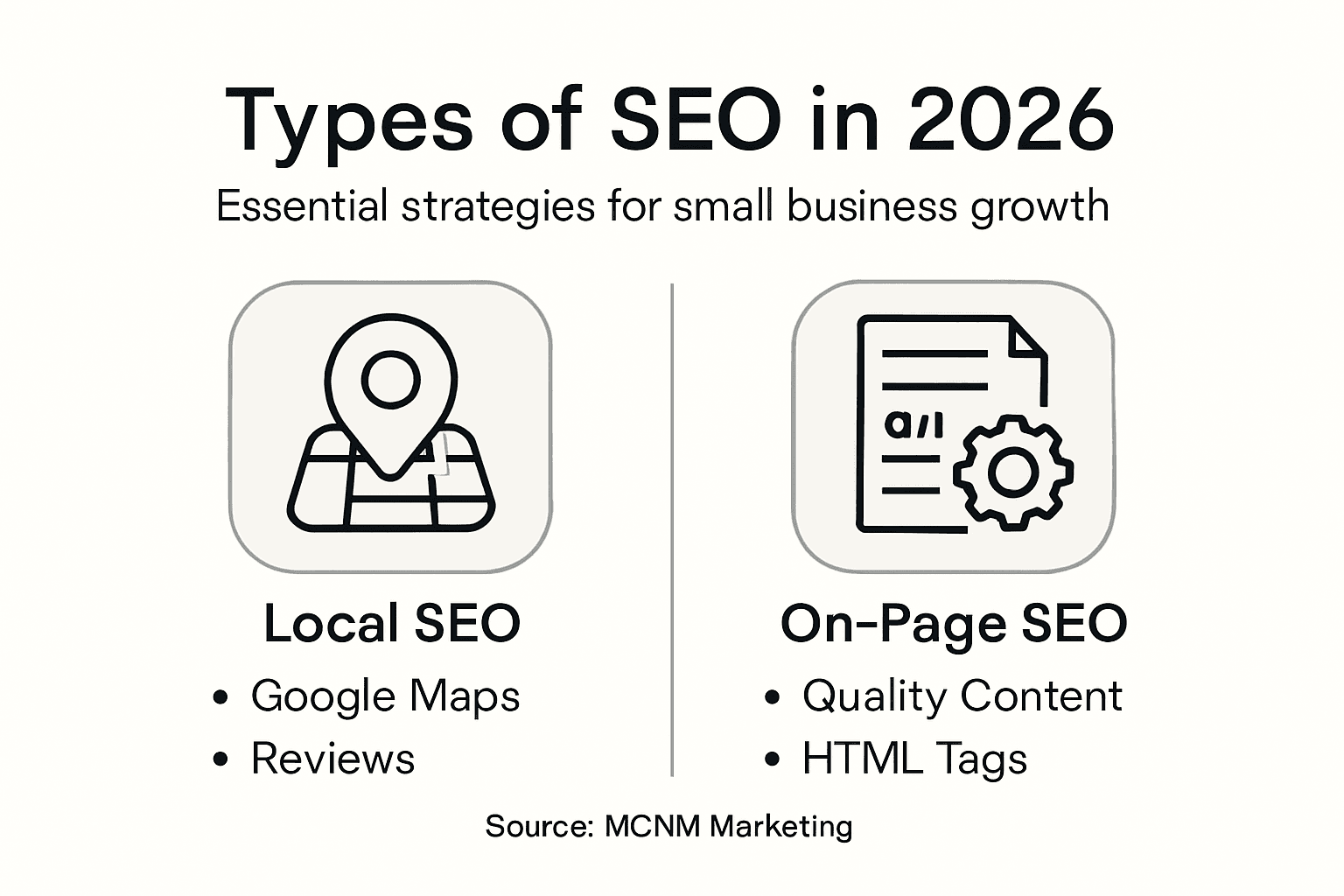
- Local SEO: Optimizing for location-based searches
- On-Page SEO: Improving website content and HTML elements
- Technical SEO: Enhancing website performance and crawlability
- Mobile SEO: Ensuring mobile device responsiveness
- Content SEO: Creating high-quality, relevant content
Small businesses particularly benefit from Local SEO, which helps them appear in geographically targeted search results. This approach involves:
- Optimizing Google Business Profile
- Gathering local customer reviews
- Creating location-specific content
- Using local keywords
- Building local backlinks
Additionally, Technical SEO plays a crucial role in small business websites by ensuring:
Here's a comparison of key SEO types and their best-fit use cases for small businesses:
| SEO Type | Best For | Primary Focus |
|---|---|---|
| Local SEO | Brick-and-mortar stores | Gaining regional customers |
| Technical SEO | All small websites | Improving site speed & security |
| Content SEO | Blogs, service sites | High-value, relevant articles |
| Mobile SEO | Sites with mobile users | Responsive design, mobile speed |
- Fast page loading speeds
- Mobile responsiveness
- Secure website connections (HTTPS)
- Clean site architecture
- Schema markup implementation
Effective SEO for small businesses is about targeted, strategic improvements that maximize online visibility and customer engagement.
Pro tip: Prioritize consistent, high-quality local content and regular performance monitoring to continuously improve your SEO strategy.
Key Benefits: Visibility, Trust, Conversions
Strategic SEO benefits transform small businesses' online presence by delivering measurable growth across multiple critical digital marketing dimensions. Search Engine Optimization provides a powerful mechanism for increasing visibility, building customer trust, and driving meaningful conversions.
The key visibility advantages of SEO include:
- Appearing in top organic search results
- Increasing website traffic
- Expanding brand recognition
- Reaching targeted audience segments
- Competing effectively with larger businesses
Trust-building happens through several strategic mechanisms:
- Demonstrating industry expertise
- Creating high-quality content
- Achieving consistent search engine rankings
- Providing transparent, valuable information
- Establishing brand authority
Conversion optimization emerges as a critical SEO benefit, with businesses experiencing significant improvements in:
- Lead generation rates
- Sales pipeline development
- Customer engagement metrics
- Return on marketing investment
- Targeted audience acquisition
SEO transforms digital visibility from a challenge into a strategic business advantage.
Small businesses particularly benefit from SEO's ability to level the competitive landscape. By implementing targeted optimization strategies, even modest organizations can compete effectively with larger enterprises, reaching potential customers precisely when they're seeking relevant solutions.

Pro tip: Regularly audit and update your SEO strategy to maintain competitive edge and adapt to evolving search engine algorithms.
SEO for Faith-Based and Nonprofit Goals
SEO strategies for nonprofit organizations provide unique opportunities to amplify mission-driven communication and expand digital outreach. Faith-based and nonprofit entities can leverage targeted optimization techniques to connect more effectively with supporters, donors, and community members seeking meaningful engagement.
Key SEO focus areas for mission-driven organizations include:
- Mission-aligned keyword optimization
- Mobile-friendly website design
- Localized content strategies
- Transparent storytelling
- Impact-driven content creation
Nonprofit SEO strategies specifically help organizations:
- Increase visibility for donation opportunities
- Attract potential volunteers
- Share organizational impact stories
- Build community trust
- Expand mission awareness
The digital engagement process for faith-based groups requires a nuanced approach that balances technical optimization with authentic storytelling. Successful nonprofits understand that SEO is not just about ranking higher, but about creating meaningful connections that inspire action and support.
Keyword research becomes particularly important, focusing on terms that reflect:
- Community needs
- Service offerings
- Volunteer opportunities
- Donation pathways
- Impact measurement
Effective SEO transforms nonprofit digital presence from passive information sharing to active community engagement.
Pro tip: Develop content that authentically reflects your organization's mission while strategically incorporating searchable keywords to maximize online visibility.
Cost, ROI, and Risks for Small Businesses
SEO investment strategies reveal complex financial considerations for small businesses navigating digital marketing landscapes. Understanding the nuanced economics of Search Engine Optimization helps entrepreneurs make informed decisions about allocating marketing resources.
Cost ranges for SEO services vary dramatically:
- Basic local SEO: $500-$1,500 monthly
- Intermediate regional campaigns: $1,500-$3,500 monthly
- Comprehensive national strategies: $3,500-$20,000 monthly
- Project-based pricing options
- Performance-based contract structures
The potential Return on Investment (ROI) for SEO demonstrates impressive outcomes:
- Average ROI of 550% across industries
- Long-term traffic generation
- Sustainable marketing channel
- Compounding visibility benefits
- Cost-effective compared to paid advertising
Critical risks small businesses must consider include:
- Slow initial results
- Fluctuating search engine algorithms
- Competitive keyword landscapes
- Potential short-term performance volatility
- Technical complexity of implementation
SEO represents a strategic investment that rewards patience and consistent optimization efforts.
Pricing models for small businesses typically involve:
To help evaluate SEO investments, here is a summary of cost, ROI, and common risks:
| Aspect | Typical Range or Impact | Business Consideration |
|---|---|---|
| Monthly Cost | $500 to $20,000+ | Scale based on business goals |
| Typical ROI | 400% to 600% over time | Significantly exceeds ad ROI |
| Main Risks | Delayed results, algorithm shifts | Requires patience, monitoring |
- Monthly retainer agreements
- Hourly consultation rates
- Project-specific pricing
- Performance-based compensation
Pro tip: Start with a modest budget, track measurable outcomes, and incrementally increase investment as you validate positive returns.
Unlock Sustainable Small Business Growth with Purpose-Driven SEO Solutions
SEO is essential for small businesses aiming to boost visibility, build trust, and convert more customers in 2026. If you feel overwhelmed by technical SEO challenges or uncertain how to create high-quality, mission-aligned content that resonates locally, you are not alone. Many organizations struggle to balance these critical SEO elements while maintaining authentic communication and steady growth. MCNM Marketing specializes in overcoming these pain points with faith-driven, AI-powered strategies designed to enhance your website’s performance and outreach. Our expertise spans website development, marketing automation, and tailored SEO solutions that align perfectly with your small business goals.
Start transforming your digital presence today by partnering with MCNM Marketing. Visit our site to explore how our customized WordPress platforms and optimized local SEO strategies can elevate your brand’s authority and audience engagement. Discover more about our comprehensive SEO services and faith-based marketing approach that puts your mission at the heart of growth. Take control of your business future with proven tactics and continuous support that drive results. Don’t wait to make your small business the trusted choice in your community.
Frequently Asked Questions
What are the primary benefits of using SEO for small businesses in 2026?
SEO enhances visibility, builds trust with customers, and drives conversions. It helps small businesses appear in top search results, attracting targeted audiences effectively.
How does Local SEO specifically benefit small businesses?
Local SEO optimizes a business's online presence for location-based searches, allowing small businesses to connect with potential customers in their area through tools like Google Business Profile optimization and localized content creation.
What are the essential components of an effective SEO strategy for small businesses?
Key components include local SEO optimization, on-page SEO (content and HTML improvements), technical SEO (site performance and security), mobile SEO (responsiveness), and content SEO (high-quality, relevant material).
How can small businesses measure the success of their SEO efforts?
Success can be measured through metrics such as website traffic, search engine ranking positions, lead generation rates, conversion rates, and overall return on investment (ROI) from SEO initiatives.
Recommended
- Search Engine Optimization (SEO) | AI and Digital Marketing Service by MCNM
- AI Tools for Small Business Growth in 2025 | AI and Digital Marketing Service by MCNM
- Blog | AI and Digital Marketing Service by MCNM
- Services | AI and Digital Marketing Service by MCNM
- Local SEO for Real Estate – Attracting Luxury Clients