

Many faith-based nonprofit leaders find themselves searching for new ways to strengthen donor engagement and accelerate digital marketing success. The growing presence of Artificial Intelligence is offering organizations worldwide transformative opportunities to overcome common challenges, improve personalized outreach, and drive deeper community impact. This overview will help you clearly understand how AI solutions can support your mission by enhancing operational efficiency and ethical decision making—while bridging technological gaps for organizations of all sizes.
Table of Contents
- Defining AI Solutions in Nonprofits
- Major Types of AI Tools for Nonprofits
- How AI Drives Engagement and Fundraising
- Implementing AI: Costs, Safety, and Ethics
- Common Challenges and Proven Successes
Key Takeaways
| Point | Details |
|---|---|
| AI Enhances Nonprofit Operations | Nonprofits can leverage AI for engagement, decision making, and operational optimization, transforming how they fulfill their missions. |
| Ethical Implementation is Crucial | Careful consideration of data privacy and ethical frameworks is necessary to build trust and maintain integrity while adopting AI solutions. |
| Diverse AI Tools Available | Nonprofits can utilize various AI tools, such as predictive analytics and chatbots, to improve engagement and efficiency in their operations. |
| Common Challenges Exist | Resource constraints, data quality issues, and organizational resistance are significant barriers, highlighting the need for tailored, scalable AI solutions. |
Defining AI Solutions in Nonprofits
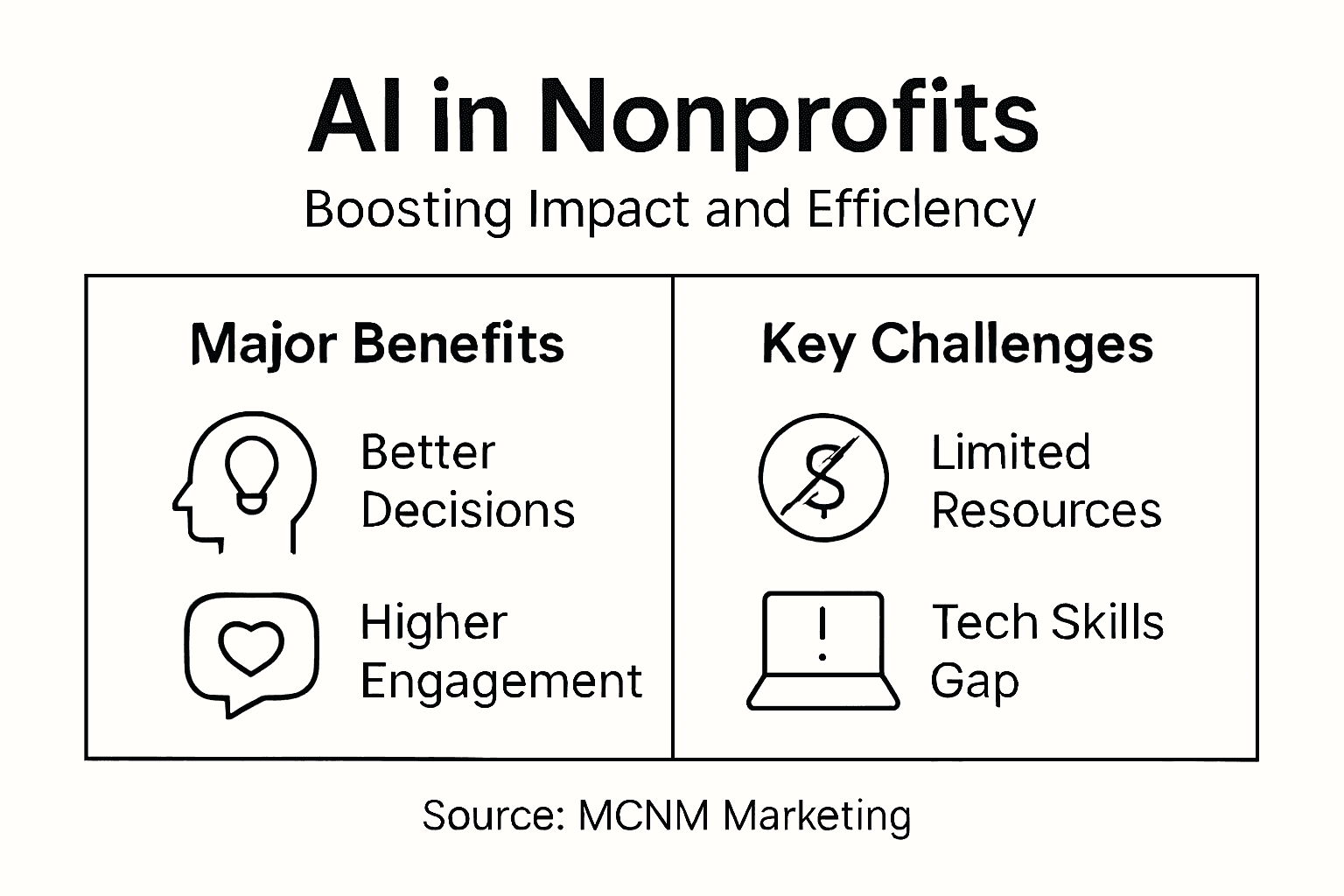
Artificial Intelligence (AI) represents a transformative technology that is fundamentally reshaping how nonprofits operate and deliver their missions. Emerging AI capabilities are providing unprecedented opportunities for organizations to enhance their strategic impact and operational efficiency.
Nonprofits can leverage AI solutions across multiple critical domains, including:
- Engagement: Personalizing communication and donor interactions
- Decision Making: Utilizing predictive analytics for strategic planning
- Optimization: Streamlining resource allocation and operational processes
- Creativity: Generating innovative approaches to complex social challenges
- Prediction: Forecasting trends and potential organizational needs
The systematic integration of AI requires a strategic approach that balances technological potential with ethical considerations. Organizations must carefully evaluate their unique needs and develop responsible implementation frameworks that protect data privacy and maintain organizational values.
AI adoption rates vary significantly across the nonprofit sector, with smaller organizations often facing greater challenges in technological integration. This digital divide underscores the importance of accessible, scalable AI solutions that can support mission-driven work regardless of organizational size.
Pro tip: Start your AI journey by conducting a comprehensive assessment of your current technological infrastructure and identifying specific operational bottlenecks where AI could provide immediate, measurable improvements.
Major Types of AI Tools for Nonprofits
Nonprofits today are leveraging a diverse array of AI technologies to transform their operational capabilities, addressing critical challenges across multiple organizational domains. These sophisticated tools enable nonprofits to enhance efficiency, improve decision-making, and amplify their social impact.
The primary categories of AI tools for nonprofits include:
- Large Language Models: Generating content, drafting communications, and personalizing donor interactions
- Predictive Analytics: Forecasting donor behavior, identifying funding opportunities, and assessing program effectiveness
- Machine Learning: Analyzing complex datasets to uncover insights and optimize resource allocation
- Automation Tools: Streamlining administrative tasks, managing workflows, and reducing operational overhead
- Natural Language Processing: Improving communication strategies and understanding sentiment in donor feedback
- Chatbots and Virtual Assistants: Providing 24/7 support, answering queries, and enhancing stakeholder engagement
Each AI tool category presents unique advantages for mission-driven organizations. Predictive analytics, for instance, can help nonprofits anticipate donor trends and develop more targeted fundraising strategies. Machine learning algorithms can process vast amounts of data to identify patterns that human analysts might overlook, enabling more strategic decision-making.
Here's a summary of primary AI tool categories and their nonprofit business impact:
| AI Tool Type | Main Use Case | Business Impact |
|---|---|---|
| Large Language Models | Content creation, outreach | Enhanced donor communication |
| Predictive Analytics | Donor behavior forecasting | Improved fundraising accuracy |
| Machine Learning | Data pattern detection | Smarter resource allocation |
| Automation Tools | Routine task management | Reduced administrative effort |
| Natural Language Processing | Sentiment interpretation | Refined outreach strategies |
| Chatbots & Assistants | Stakeholder support | Increased engagement |
However, successful AI implementation requires a nuanced approach. Organizations must balance technological potential with ethical considerations, ensuring that AI tools complement human expertise rather than replace critical human judgment. Data privacy, transparency, and responsible use remain paramount in maintaining organizational integrity and stakeholder trust.
Pro tip: Conduct a comprehensive technology audit to identify specific operational bottlenecks where AI tools can provide the most immediate and measurable improvements for your nonprofit.
How AI Drives Engagement and Fundraising
AI is revolutionizing donor engagement by enabling nonprofits to create highly personalized communication strategies that dramatically improve fundraising outcomes. By leveraging advanced data analytics and machine learning, organizations can now understand and connect with donors in unprecedented ways.
Key strategies for AI-powered engagement include:
- Personalized Communication: Tailoring messages to individual donor preferences and giving history
- Predictive Donor Modeling: Identifying potential high-value donors and their likelihood of contributing
- Sentiment Analysis: Understanding donor emotional responses and motivations
- Targeted Campaign Design: Creating more effective fundraising campaigns based on data-driven insights
- Donor Retention Optimization: Predicting and preventing donor churn
- Real-time Interaction Tracking: Monitoring donor engagement across multiple channels
The transformative power of AI extends beyond simple data analysis. Predictive analytics enable nonprofits to anticipate donor behaviors, developing more sophisticated and nuanced fundraising approaches. Machine learning algorithms can process complex datasets, uncovering patterns that traditional analysis might miss, thereby helping organizations develop more strategic and targeted outreach efforts.

However, successful AI implementation requires a delicate balance. Nonprofits must maintain the human touch that donors value, using AI as a tool to enhance rather than replace genuine human connection. Ethical considerations, data privacy, and transparent communication remain crucial in maintaining donor trust and organizational integrity.
Pro tip: Develop a comprehensive AI integration strategy that prioritizes donor relationships, focusing on using technology to deepen rather than automate human connections.
Implementing AI: Costs, Safety, and Ethics
Nonprofits must carefully navigate the complex landscape of AI implementation, balancing technological potential with comprehensive ethical and safety considerations. The journey involves strategic planning, financial investment, and a thoughtful approach to mitigating potential risks.
Key considerations for responsible AI adoption include:
- Cost Assessment: Evaluating initial technology investment and long-term operational expenses
- Staff Training: Developing internal capabilities to effectively use and manage AI tools
- Data Privacy: Implementing robust protection mechanisms for sensitive information
- Bias Mitigation: Identifying and addressing potential algorithmic biases
- Transparency: Maintaining clear communication about AI use with stakeholders
- Ethical Frameworks: Developing guidelines that align AI implementation with organizational values
Budgetary planning represents a critical initial step for nonprofits considering AI integration. Organizations must consider not just the upfront technology costs, but also ongoing expenses related to training, maintenance, and potential system upgrades. Small to medium-sized nonprofits might find more cost-effective solutions through modular AI tools or cloud-based services that offer scalable pricing models.
Ethical considerations remain paramount in AI adoption. Nonprofits must develop comprehensive governance frameworks that prioritize human oversight, protect individual privacy, and ensure algorithmic fairness. This involves creating clear policies around data use, establishing mechanisms for ongoing algorithmic auditing, and maintaining a commitment to transparency that builds trust with donors, beneficiaries, and stakeholders.
Pro tip: Develop a phased AI implementation strategy that starts with low-risk pilot projects, allowing your organization to build expertise and confidence while carefully managing potential technological and ethical challenges.
Common Challenges and Proven Successes
Nonprofits navigating AI adoption encounter a complex landscape of challenges and opportunities, revealed through systematic organizational analysis. The journey involves understanding and overcoming significant technological, operational, and strategic barriers while leveraging AI's transformative potential.
Primary challenges nonprofits face include:
- Resource Constraints: Limited budgets and technological infrastructure
- Technical Expertise: Shortage of staff with advanced AI skills
- Data Quality: Inconsistent or incomplete organizational data
- Organizational Resistance: Cultural barriers to technological change
- Ethical Uncertainties: Concerns about algorithmic bias and privacy
- Scalability: Difficulty implementing AI solutions across diverse programs
Successful AI implementation requires a nuanced approach that balances technological potential with organizational readiness. Smaller nonprofits can achieve meaningful progress by starting with targeted, low-risk AI applications that demonstrate clear value and build internal confidence. Larger organizations often benefit from creating dedicated innovation teams that can pilot and scale AI technologies across different operational domains.
Compare common challenges and success factors in nonprofit AI integration:
| Challenge | Typical Barrier | Success Factor |
|---|---|---|
| Resource Constraints | Limited funding | Modular, scalable solutions |
| Staff Expertise | Skill gaps in AI technology | Ongoing staff training |
| Data Quality | Incomplete records | Robust data governance |
| Organizational Resistance | Change aversion | Leadership commitment |
| Ethical Concerns | Algorithmic bias risks | Transparent oversight |
Moreover, nonprofits that have successfully integrated AI typically share common characteristics: strong leadership commitment, continuous staff training, robust data governance frameworks, and a willingness to experiment and learn. These organizations view AI not as a replacement for human expertise, but as a powerful tool to augment human capabilities and drive mission-driven impact.
Pro tip: Create a cross-functional AI task force that includes representatives from technology, program, and leadership teams to ensure holistic and strategic AI adoption.
Unlock AI’s Full Potential for Your Faith-Based or Nonprofit Organization
The article highlights the challenges nonprofits face in adopting AI such as limited resources, the need for ethical implementation, and building meaningful donor engagement. MCNM Marketing specializes in addressing these exact pain points by offering tailored AI-powered solutions designed to boost your mission’s impact and operational efficiency. With expertise in WordPress website development, marketing automation, and SEO, MCNM helps nonprofits overcome technological barriers while preserving the human connection that donors value.
Imagine using advanced automation tools and predictive analytics to personalize donor communication and optimize fundraising efforts without sacrificing your organization’s core values. Our purpose-driven approach ensures your digital strategies align with your faith-based mission and community goals.
Ready to transform how your nonprofit engages supporters and expands outreach? Visit MCNM Marketing to explore our comprehensive services. Start your AI-powered journey today with custom website development and strategic marketing automation designed specifically for mission-driven organizations. Don’t wait—empower your nonprofit with AI that respects your values and magnifies your impact now.
Frequently Asked Questions
What are the main benefits of using AI in nonprofits?
Using AI in nonprofits can enhance engagement, improve decision-making, streamline operations, foster creativity, and predict trends. These benefits allow organizations to boost their impact and efficiency in delivering their missions.
How can AI improve donor engagement for nonprofits?
AI can enhance donor engagement by personalizing communication, predicting donor behavior, analyzing sentiment, and optimizing fundraising strategies. This leads to more effective and targeted outreach, which can increase donor contributions and retention.
What challenges do nonprofits face when implementing AI solutions?
Common challenges include limited resources, lack of technical expertise, concerns about data quality, resistance to change within the organization, ethical considerations regarding bias, and difficulties in scaling AI initiatives across diverse programs.
How should nonprofits evaluate their readiness for AI adoption?
Nonprofits should conduct a comprehensive assessment of their technological infrastructure, identify operational bottlenecks where AI could be beneficial, and consider the costs, ethical implications, and necessary staff training to effectively implement AI solutions.
Recommended
- AI for Grants and Revenue: How MCNM Helps Nonprofits & Small Businesses Grow | AI and Digital Marketing Service by MCNM
- AI Tools for Small Business Growth in 2025 | AI and Digital Marketing Service by MCNM
- Blog | AI and Digital Marketing Service by MCNM
- From Efficiency to Effectiveness: Generative AI’s New Role in Digital Marketing | AI and Digital Marketing Service by MCNM