

When your resources are limited but your vision is bold, every message counts. For faith-based organizations, connecting with supporters goes beyond likes or fleeting social media attention. Email marketing provides a direct, cost-effective way to nurture donor relationships, share the heart of your mission, and sustain engagement year-round. In this guide, you will discover how strategic email outreach can multiply your impact, deepen supporter loyalty, and streamline communication—all while keeping your core message front and center.
Table of Contents
- Defining Email Marketing for Nonprofit Outreach
- Key Benefits for Mission-Driven Organizations
- Types and Automation Strategies for Engagement
- Segmentation and Personalization for Donor Impact
- Compliance, Deliverability, and Avoiding Common Mistakes
Key Takeaways
| Point | Details |
|---|---|
| Emotional Connection | Nonprofit email marketing should focus on emotional storytelling to engage donors and motivate donations. |
| Ongoing Engagement | Build and maintain long-term relationships with supporters rather than prioritizing quick fundraising asks. |
| Effective Segmentation | Use segmentation to tailor messages according to donor interests and behaviors for greater impact. |
| Compliance and Deliverability | Ensure adherence to email compliance regulations to maintain trust and improve deliverability rates. |
Defining Email Marketing for Nonprofit Outreach
Email marketing for nonprofits is fundamentally different from what for-profit businesses do. Your mission isn't profit—it's impact.
Nonprofits use email as a targeted communication strategy focused on raising awareness, maintaining supporter relationships, and motivating donations. Unlike commercial organizations chasing transactions, you're building connection and trust.
Here's what nonprofit email marketing actually accomplishes:
- Shares mission impact through stories that resonate emotionally with your audience
- Maintains ongoing relationships with donors beyond fundraising campaigns
- Streamlines communications across limited staff and budget constraints
- Multiplies your reach without requiring significant financial investment
Your emails serve several purposes simultaneously. A single campaign might raise awareness about a problem, tell the story of someone your organization helped, and ask for a specific donation—all in one message.
Email marketing enables nonprofits to build and nurture relationships with donors, clients, and supporters in ways that phone calls or social media cannot. Email lives in your supporters' inboxes as a persistent reminder of your work and your need.
What makes nonprofit email different?
Here's a comparison of nonprofit and for-profit email marketing priorities:
| Focus Area | Nonprofit Emails | For-Profit Emails |
|---|---|---|
| Main Objective | Drive impact and engagement | Drive sales and revenue |
| Key Content | Mission stories, updates | Product features, discounts |
| Emotional Engagement | High priority | Moderate emphasis |
| Relationship Duration | Ongoing connection | Transaction-focused |
| Messaging Approach | Community building, trust | Persuasion, urgency |
- Emotional resonance matters more than features—people donate because they care, not because of product benefits
- Storytelling drives action—real stories about real impact convert skeptics into supporters
- Long-term relationships trump one-time asks—you're building a community, not closing a sale
- Cost-effectiveness is essential—your budget is limited, so efficiency directly impacts mission work
Nonprofit email marketing succeeds when it balances mission storytelling with clear, respectful calls to action. Your supporters want to hear how their contributions make a difference.
Many faith-based organizations and ministries overlook email as a communication channel. They focus on social media or in-person events and miss the most direct path to their supporters' attention. Email puts your message in a personal space—their inbox—where it sits until they choose to engage.
This is where strategic content creation becomes critical. Your emails need substance. They need to communicate authentically about your mission while respecting your supporters' time and attention.
Pro tip: Start viewing your email list as your most valuable asset—not as a marketing channel, but as a direct connection to people who already believe in your cause. Protect that trust by sending only meaningful, mission-focused content.
Key Benefits for Mission-Driven Organizations
Email marketing delivers tangible advantages that directly support your mission without consuming resources you don't have. For nonprofits operating on tight budgets, this matters significantly.
The return on investment is striking. Email marketing offers nonprofits approximately $36 for every $1 spent—far exceeding what traditional direct mail or paid advertising produces. You invest minimal dollars and reach supporters directly in their inboxes.
Here's what email accomplishes for mission-driven work:
- Builds stronger donor relationships through personalized, consistent communication
- Reduces communication costs compared to print mail, phone outreach, or event hosting
- Provides rich data for measuring what resonates with your audience
- Enables rapid campaign adjustments based on real-time engagement metrics
- Promotes transparency about how funds are used and impact created
Unlike social media algorithms that hide your message, email reaches supporters directly. Your content doesn't compete with cat videos or sponsored ads. It sits in their inbox waiting for their attention.
Using email marketing allows nonprofits to quickly measure success metrics and tailor campaigns to maximize both engagement and fundraising results. You see immediately who opened your message, clicked your link, and donated. This data transforms guessing into strategy.
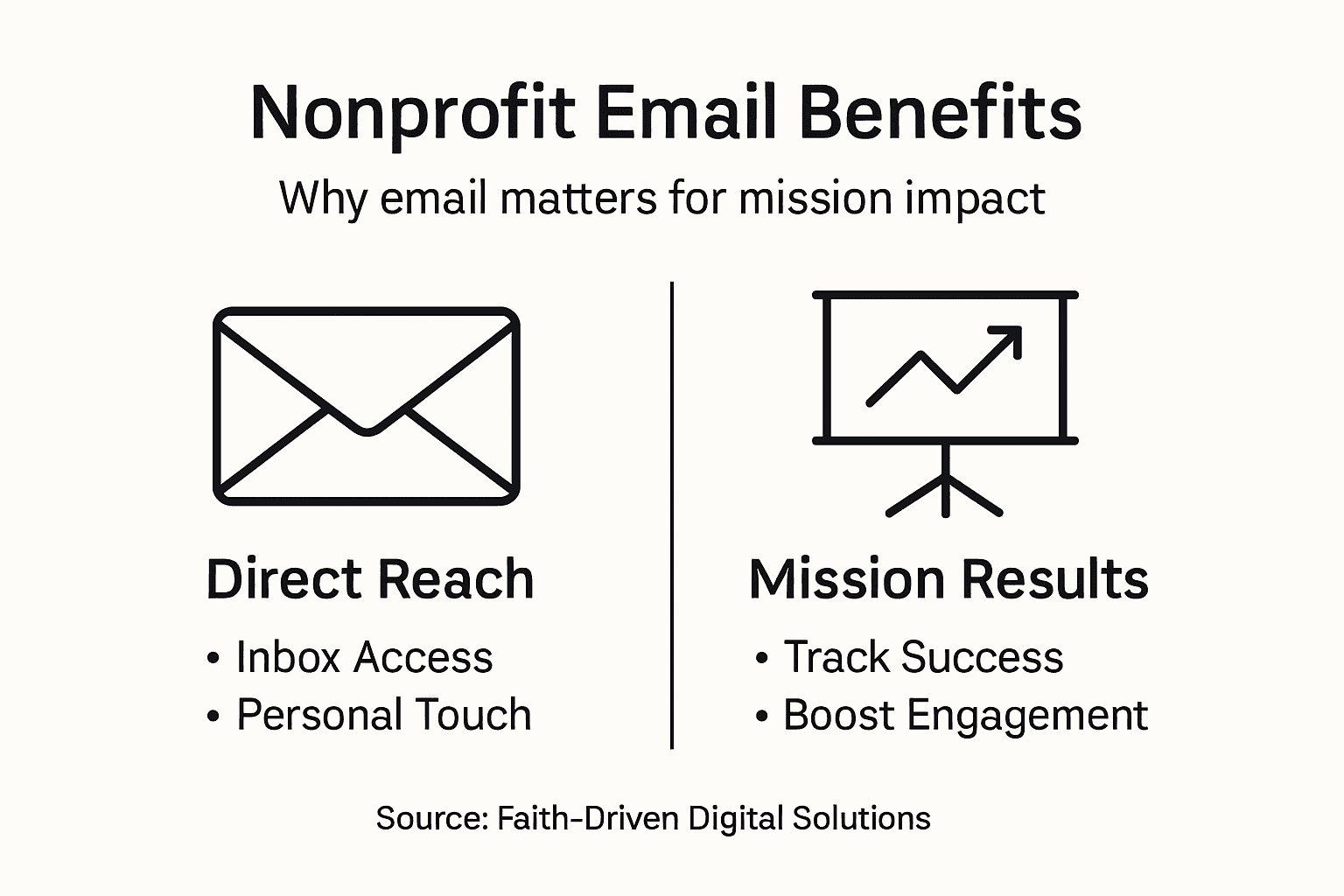
Personalization transforms email from a mass broadcast into individual conversations. A longtime donor receives different messaging than a first-time supporter. Someone interested in youth programs sees stories about youth. This relevance strengthens loyalty and increases giving.
Your limited staff can accomplish more through automation and strategic segmentation. Instead of manually reaching 500 supporters, you send one email that arrives in all their inboxes simultaneously. Your team focuses on mission work, not administrative tasks.
Email provides the measurement and personalization capabilities necessary to strengthen supporter loyalty while operating within realistic nonprofit budgets.
Faith-based organizations particularly benefit from email's ability to keep congregants and supporters consistently informed about spiritual impact, community service outcomes, and giving opportunities. Email becomes a ministry tool that extends your reach beyond Sunday services or monthly meetings.
Strategic growth through email requires planning, but the infrastructure you build today creates sustainable supporter relationships for years ahead.
Pro tip: Segment your email list by supporter type—donors, volunteers, first-time visitors, major gift prospects—and send targeted content that speaks to each group's specific interests and involvement level.
Types and Automation Strategies for Engagement
Not all nonprofit emails serve the same purpose. Different campaigns accomplish different goals, and treating them all the same wastes opportunity.
Effective nonprofit email marketing uses distinct campaign types, each tailored for unique engagement goals. Understanding which type fits your current need transforms email from a scattershot tool into a strategic weapon.
Common campaign types include:
- Donation appeals that directly ask for financial support with clear impact statements
- Event invitations that build attendance and create community connection
- Newsletters that keep supporters informed about ongoing mission work and wins
- Impact reports that demonstrate transparency and show where money went
- Volunteer calls that recruit hands-on help for specific projects
- Prayer requests that invite spiritual participation from your community
Each type requires different messaging, frequency, and emotional tone. A donation appeal hits harder and faster. A newsletter builds relationship over time. Mixing these strategically keeps your supporters engaged without overwhelming them.
Below is a summary of common nonprofit email campaign types and their best use cases:
| Campaign Type | Best Use Case | Ideal Frequency |
|---|---|---|
| Donation Appeal | Fundraising with emotional urgency | Quarterly or as needed |
| Event Invitation | Boost participation and awareness | One month before events |
| Newsletter | Maintain engagement and inform | Monthly or bi-monthly |
| Impact Report | Show transparency and build trust | Quarterly |
| Volunteer Call | Drive hands-on involvement | Project-based/as needed |
This is where automation simplifies repetitive tasks like follow-ups and segmentation-based targeting, improving outreach effectiveness and donor retention while saving time for nonprofit staff.
Automation handles the mechanical work. Set up a welcome sequence that fires automatically when someone joins your list. Send birthday acknowledgments without manual effort. Follow up with event attendees on a predetermined schedule. Your team focuses on writing compelling content while the system handles delivery.
Segmentation amplifies automation's power. Instead of one generic email to everyone, automation routes specific messages to specific people based on their history and interests. Major donors see different messaging than first-time supporters. Someone who attended a youth event automatically receives youth-focused updates.
Automation doesn't replace authentic communication—it ensures nothing falls through the cracks while your limited team focuses on mission-critical work.
Digital marketing automation platforms allow you to build workflows that nurture supporters without constant manual intervention. A new donor triggers a series of thank-you emails and impact updates. Someone who clicked but didn't donate gets a follow-up with additional information. These sequences run 24/7.
Faith-based organizations benefit tremendously from automation workflows that keep members engaged between services, remind people of giving opportunities, and celebrate ministry wins automatically.
Pro tip: Start with one automation workflow—perhaps a welcome series for new email subscribers—and refine it based on open rates and click data before building additional sequences.
Segmentation and Personalization for Donor Impact
One-size-fits-all emails underperform. A monthly donor needs different communication than someone attending their first event. Personalization is what turns generic broadcasts into meaningful conversations.

Segmentation means dividing your email list into groups based on shared characteristics. Segmenting email lists into groups such as monthly donors, event attendees, and volunteers enables nonprofits to send relevant communications that increase open and click-through rates.
Common segmentation categories include:
- Donor level (first-time, recurring, major gift prospects, lapsed)
- Engagement type (financial donors, volunteers, event attendees, prayer partners)
- Interest area (youth ministry, community service, spiritual growth, disaster relief)
- Location (local community members, distant supporters, international)
- Giving history (amount donated, frequency, date of last gift)
- Communication preference (email frequency tolerance, content topics)
Segmentation creates relevance. Someone who donated specifically to youth programs sees stories about youth impact. A local volunteer hears about upcoming volunteer opportunities in their area. Someone giving monthly gets recognized and thanked differently than a one-time donor.
Personalization in nonprofit email marketing significantly boosts engagement by delivering the right message to the right audience. Analyzing donation history and supporter interests helps customize emails, resulting in higher response rates, improved donor loyalty, and increased fundraising success.
Personalization goes far beyond using first names in subject lines. It means tailoring entire emails based on what supporters actually care about. The call-to-action changes. Stories change. Even frequency changes based on what segments prefer.
A major donor receives quarterly impact reports and personal thank-you videos. A first-time supporter gets a welcome sequence explaining your mission. Someone interested in youth programs receives monthly stories about kids' lives changed. These aren't different organizations—they're the same mission told differently.
Segmentation transforms email from broadcasting to everyone into having individual conversations with distinct groups. That difference multiplies your impact.
Faith-based organizations use segmentation to nurture different spiritual journeys. New believers receive foundational teaching. Experienced members get advanced content. Prayer partners hear about needs to intercede for. Each group feels personally seen.
AI-powered tools can identify patterns in supporter behavior that humans might miss, automatically surfacing the best giving times, preferred communication methods, and content topics for each segment.
Pro tip: Start with two or three core segments based on giving behavior—monthly donors, event attendees, and prospects—before building additional segments as your data matures.
Compliance, Deliverability, and Avoiding Common Mistakes
Your email strategy fails silently if messages never reach inboxes. Technical compliance and list hygiene matter as much as creative content.
Email deliverability depends on following established rules and maintaining sender reputation. Ensuring email deliverability is critical for nonprofit email marketing success. Organizations must follow best practices like list hygiene, permission-based marketing, and complying with regulations such as GDPR to avoid spam filters and maintain trust.
Compliance requirements for nonprofits include:
- CAN-SPAM Act (United States) requires clear identification, accurate sender info, and functional unsubscribe options
- GDPR (European Union and others) mandates explicit consent before sending and respects for data privacy
- CASL (Canada) enforces strict permission-based rules similar to GDPR
- State privacy laws add requirements depending on supporter location
Ignoring these isn't just risky legally. Spam complaints tank your sender reputation, making future legitimate emails land in spam folders.
List hygiene and regular monitoring of deliverability rates help maximize email effectiveness. To maximize email effectiveness, nonprofits must adhere to compliance standards and maintain clean email lists. Avoiding frequent pitfalls like over-emailing, generic messaging, and ignoring analytics helps improve engagement and keeps supporters receptive to future campaigns.
Clean lists mean removing inactive addresses, correcting bouncing emails, and honoring unsubscribe requests immediately. A smaller engaged list outperforms a massive list full of inactive or invalid addresses.
Common mistakes that harm nonprofits:
- Neglecting measurement—you can't improve what you don't track
- Poor segmentation—sending identical emails to different supporter types
- Inconsistent messaging—different tone or mission focus across campaigns
- Over-emailing—bombarding supporters and causing unsubscribes
- Ignoring bounce rates—letting invalid addresses accumulate
- Missing unsubscribe links—violating regulations and annoying supporters
Compliance isn't bureaucracy—it's the foundation that keeps your messages reaching supporters and your organization trusted.
Faith-based organizations especially need strong compliance practices. Supporters give generously when they trust you handle their information carefully and respect their preferences. One privacy violation damages reputation quickly.
Pro tip: Audit your email list quarterly by removing addresses that haven't opened emails in 12 months and verifying that all campaigns include clear unsubscribe options and sender information.
Unlock the True Power of Nonprofit Email Marketing with Faith-Driven Digital Solutions
Email marketing is essential for nonprofits aiming to build lasting donor relationships and drive impactful engagement through mission storytelling and personalized outreach. If you struggle with segmentation, automation, or delivering consistent, meaningful content that respects your supporters' trust, MCNM Marketing offers purpose-led strategies specially tailored for faith-based organizations and ministries. We understand the challenge of balancing mission impact with limited resources, and we provide AI-powered tools and WordPress solutions that amplify your reach while making your communication both effective and efficient.
Key benefits you gain include:
- Scalable website development optimized for nonprofit growth
- Marketing automation designed to nurture supporters with personalized journeys
- Data-driven email campaigns that boost donor loyalty and increase giving
Ready to transform your email marketing from generic broadcasts to heartfelt conversations that build community and trust? Visit MCNM Marketing today to explore how our tailored digital growth strategies can unlock new levels of supporter engagement. Don’t wait to harness automation, segmentation, and AI-powered insights to maximize your mission impact and sustain your faith-based outreach.
Get started now by learning more about our digital marketing automation services and content creation guidance designed specifically for nonprofits like yours.
Frequently Asked Questions
What is email marketing for nonprofits?
Email marketing for nonprofits is a targeted communication strategy that focuses on building relationships, sharing mission impact, and motivating donations, rather than driving sales like for-profit businesses.
How does email marketing benefit nonprofits?
Email marketing helps nonprofits build stronger relationships with donors, reduce communication costs, provide measurable engagement data, and promote transparency about how contributions are used, all while operating within tight budgets.
What types of email campaigns should nonprofits use?
Nonprofits should utilize various types of email campaigns such as donation appeals, event invitations, newsletters, impact reports, volunteer calls, and prayer requests to engage different segments of their audience effectively.
How important is personalization in nonprofit email campaigns?
Personalization is crucial as it transforms generic emails into meaningful conversations, allowing nonprofits to tailor messages based on donor interests, giving history, and engagement type, which significantly increases open and response rates.
Recommended
- Why Use AI in Nonprofits: Boosting Impact and Efficiency | AI and Digital Marketing Service by MCNM
- Digital Growth Strategy: Shaping Nonprofit Impact | AI and Digital Marketing Service by MCNM
- Content Creation Guide for Maximizing Nonprofit Impact | AI and Digital Marketing Service by MCNM
- 7 Smart AI Tools for Small Business Growth Success | AI and Digital Marketing Service by MCNM