

Struggling to capture attention and inspire action online is a reality for many nonprofits and faith-based organizations. Understanding digital marketing is vital for leaders who want to build stronger outreach and increase donations. By harnessing personalized, engaging experiences and combining interactive strategies—from social media to AI-driven tools—faith-driven nonprofits can amplify their message, foster authentic connections, and drive transformational results.
Table of Contents
- Digital Marketing Defined and Misunderstood
- Core Types and How They Work Together
- AI, Automation, and Purpose-Led Trends
- Key Strategies for Nonprofits and Ministries
- Common Pitfalls and Ethical Considerations
Key Takeaways
| Point | Details |
|---|---|
| Digital Marketing Essentials | It focuses on creating personalized and engaging experiences through various interactive digital channels. |
| Integrative Strategies | Different channels like SEO, SMM, and Content Marketing must be strategically combined for cohesive messaging and effective customer journeys. |
| AI Impact | AI significantly enhances marketing by facilitating personalized engagement and optimizing performance, while ethical considerations remain crucial. |
| Ethical Considerations | Organizations need to prioritize data transparency and user consent to maintain trust and avoid manipulative practices. |
Digital Marketing Defined and Misunderstood
Digital marketing represents a dynamic and complex approach to reaching customers through digital technologies and interactive platforms. At its core, digital marketing goes far beyond traditional advertising by creating personalized, engaging experiences that connect businesses directly with their target audiences.
The landscape of digital marketing is characterized by several distinctive features that set it apart from conventional marketing strategies:
- Ubiquitous connectivity enabling real-time communication
- Personalization of marketing messages and experiences
- Peer-to-peer networking that amplifies content reach
- Interactive engagement with potential customers
- Immersive content creation that builds meaningful connections
Traditional marketing approaches focused on one-way communication, but digital marketing transforms engagement into a multilayered, interactive process. Customers are no longer passive recipients of information but active participants who can provide immediate feedback, share content, and influence brand perceptions.
Modern digital marketing strategies leverage multiple channels—social media, email, websites, mobile apps—to create comprehensive, integrated experiences. The goal is not just to broadcast messages but to build genuine relationships that drive meaningful interactions and conversions.
Pro tip: Develop a holistic digital marketing strategy that prioritizes customer experience and leverages multiple interactive channels for maximum engagement.
Core Types and How They Work Together
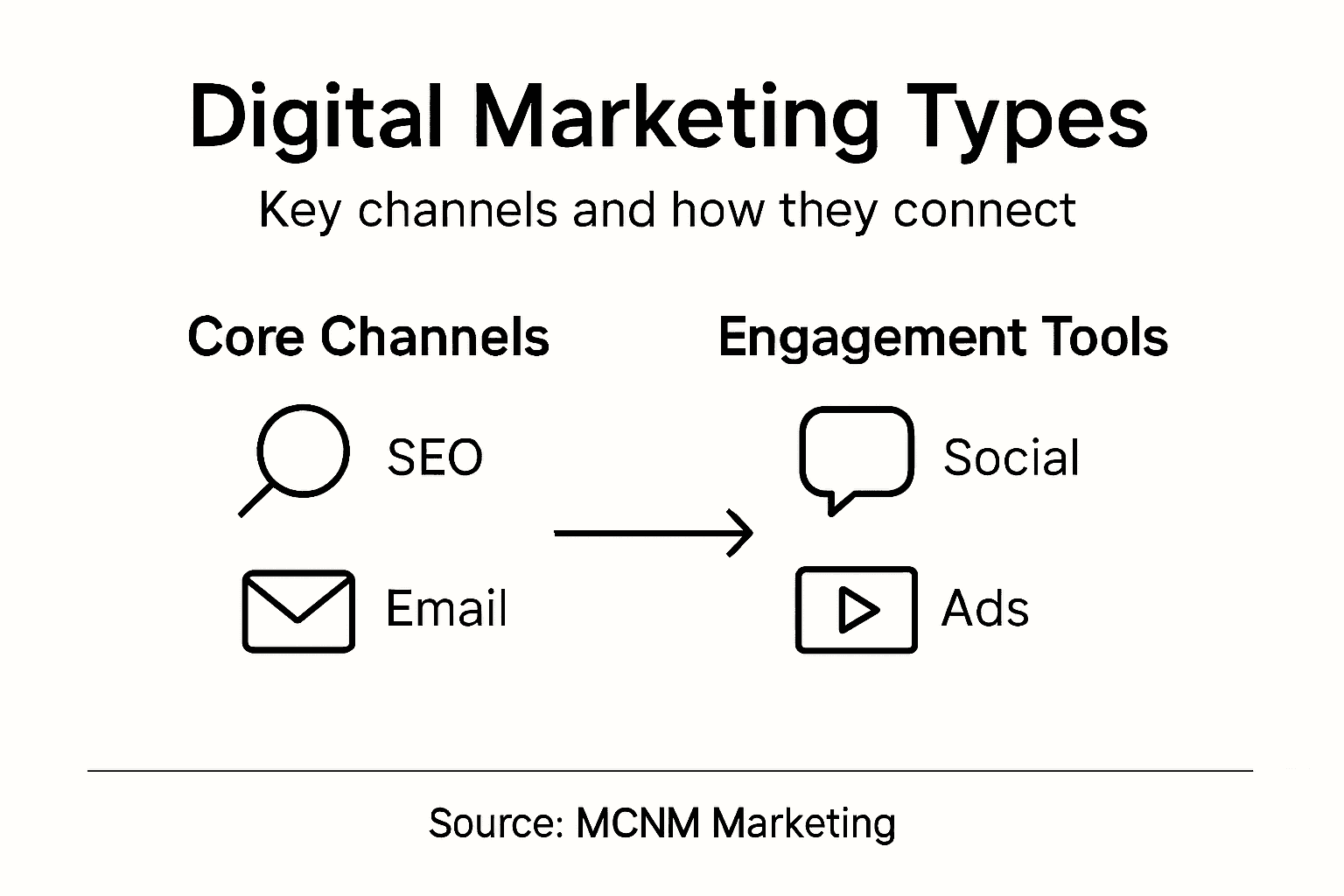
Digital marketing is not a single monolithic strategy but a sophisticated ecosystem of interconnected channels that work together to achieve comprehensive business objectives. Core marketing types create a synergistic approach to reaching and engaging potential customers across multiple touchpoints.
The primary types of digital marketing include:
- Search Engine Optimization (SEO) for organic visibility
- Social Media Marketing (SMM) for audience engagement
- Search Engine Marketing (SEM) for targeted advertising
- Content Marketing for building authority and trust
- Email Marketing for direct communication
- Affiliate Marketing for expanded reach
- Video and Influencer Marketing for storytelling and credibility
Each digital marketing channel serves a unique purpose in the customer journey. SEO focuses on improving organic search rankings, social media fosters community engagement, and paid advertising targets high-intent customers with precision. The magic happens when these channels are strategically integrated to create a cohesive marketing experience.
Successful digital marketing requires a holistic approach that combines audience research, platform selection, and continuous measurement. Businesses must understand how different channels complement each other, creating a seamless narrative that guides potential customers from initial awareness to final conversion.

To better understand how digital marketing channels complement each other, see this integrated channel comparison:
| Channel | Primary Strength | Key Role in Funnel |
|---|---|---|
| SEO | Long-term organic visibility | Drives initial discovery |
| Social Media Marketing | Audience engagement & sharing | Builds brand community |
| Content Marketing | Thought leadership | Nurtures and educates |
| Email Marketing | Direct personalized outreach | Converts and retains leads |
Pro tip: Develop an integrated digital marketing strategy that aligns multiple channels, ensuring consistent messaging and tracking performance across all platforms.
AI, Automation, and Purpose-Led Trends
Artificial Intelligence is rapidly transforming digital marketing, introducing unprecedented capabilities that redefine how businesses engage with customers. AI-driven marketing strategies are revolutionizing traditional approaches by enabling more personalized, efficient, and data-driven experiences.
The key emerging trends in AI-powered digital marketing include:
- Predictive analytics for precise customer insights
- Automated content creation reducing manual workload
- Personalized customer engagement at scale
- Intelligent chatbots for 24/7 customer interaction
- Hyper-targeted advertising using machine learning
- Real-time performance optimization
Marketers must recognize that AI is not about replacing human creativity but augmenting human capabilities through intelligent automation. The most successful strategies will combine technological efficiency with genuine human insight, ensuring that marketing remains authentic and purposeful.
Ethical considerations are paramount in this AI-driven landscape. Businesses must prioritize transparency, data privacy, and responsible AI deployment to maintain consumer trust and avoid potential backlash. The goal is not just technological advancement, but creating meaningful connections that respect individual privacy and preferences.
Pro tip: Invest in continuous AI skill development and maintain a balanced approach that combines technological innovation with human empathy and ethical considerations.
Key Strategies for Nonprofits and Ministries
Digital marketing for nonprofits and ministries requires a nuanced approach that balances technological innovation with mission-driven storytelling. Strategic digital outreach has become essential for organizations seeking to expand their impact and engage supporters in meaningful ways.
Key digital marketing strategies for mission-driven organizations include:
- Transparent storytelling that demonstrates real-world impact
- Mobile-first website design for seamless user experience
- Short-form video content highlighting organizational missions
- Personalized donor communication using AI technologies
- Search engine optimization to increase visibility
- Social media community building
Nonprofits must focus on creating user-friendly digital platforms that communicate their mission effectively. This means developing websites with clear calls-to-action, optimizing content for mobile users, and leveraging digital channels to build genuine connections with supporters.
Ethical data use and transparency are paramount in digital marketing for mission-driven organizations. Donors and supporters want to understand how their engagement translates into real-world impact. By combining technological tools with authentic storytelling, nonprofits can create powerful digital experiences that inspire action and foster long-term community support.
Pro tip: Develop a comprehensive digital strategy that prioritizes storytelling, ethical data practices, and measurable impact demonstration.
Common Pitfalls and Ethical Considerations
Digital marketing ethics represent a critical intersection between technological capability and human responsibility. Ethical challenges in digital marketing have become increasingly complex with the rapid advancement of artificial intelligence and data collection technologies.
Key ethical pitfalls organizations must navigate include:
- Data privacy violations
- Manipulative marketing practices
- Unauthorized data collection
- Synthetic media misuse
- Algorithmic bias in targeting
- Lack of transparency in marketing strategies
Businesses and nonprofits must recognize that maintaining consumer trust requires more than legal compliance. Ethical digital marketing demands a proactive approach that prioritizes user consent, data protection, and transparent communication. This means implementing robust data governance frameworks, obtaining clear user permissions, and being consistently transparent about how data is collected, used, and protected.
Technology should enhance human connections, not replace them. Organizations must develop sophisticated ethical guidelines that go beyond minimum legal requirements, focusing on creating marketing strategies that respect individual autonomy, protect personal information, and contribute positively to societal welfare. The goal is to build trust through responsible, empathetic digital engagement.
Ethical challenges in digital marketing can be grouped by risk and recommended action:
| Ethical Pitfall | Main Risk | Mitigation Approach |
|---|---|---|
| Data privacy violation | Loss of consumer trust | Transparent data policies |
| Algorithmic bias | Unfair targeting | Regular audits |
| Manipulative practices | Damage to reputation | Ethical marketing review |
Pro tip: Develop a comprehensive ethical marketing framework that prioritizes user consent, data transparency, and human-centered technology implementation.
Strengthen Your Mission with Purpose-Driven Digital Marketing
If your nonprofit or ministry struggles to create engaging and personalized digital experiences, MCNM Marketing offers tailored AI-powered solutions designed just for you. The article emphasizes the importance of integrating SEO, automation, and ethical storytelling to build trust and foster genuine connections—challenges we address through our faith-driven approach and technical expertise.
Unlock the power of:
- Customized WordPress websites optimized for mission-driven outreach
- AI-enhanced marketing automation that personalizes donor communication
- Ethical SEO strategies that increase your visibility and impact
Ready to elevate your digital presence with a strategy rooted in purpose and trust Visit MCNM Marketing now to discover how our customized solutions can help you reach more supporters and amplify your impact. Explore our specialized services and start building meaningful connections today at MCNM Marketing. Learn more about how we combine technology with faith-inspired storytelling at MCNM Marketing.
Frequently Asked Questions
What is digital marketing?
Digital marketing is a strategic approach that utilizes digital technologies and interactive platforms to connect businesses with their target audiences, focusing on personalized, engaging experiences.
How does digital marketing differ from traditional marketing?
Unlike traditional marketing, which often involves one-way communication, digital marketing creates interactive, two-way conversations between brands and customers, allowing for real-time feedback and engagement.
What are the core types of digital marketing?
The core types of digital marketing include Search Engine Optimization (SEO), Social Media Marketing (SMM), Search Engine Marketing (SEM), Content Marketing, Email Marketing, Affiliate Marketing, and Video Marketing, each serving different roles in the customer journey.
Why is ethical digital marketing important?
Ethical digital marketing is crucial for maintaining consumer trust. It requires transparency, data privacy, and responsible use of technology to ensure a respectful and authentic engagement with audiences.
Recommended
- From Efficiency to Effectiveness: Generative AI’s New Role in Digital Marketing | AI and Digital Marketing Service by MCNM
- Search Engine Optimization (SEO) | AI and Digital Marketing Service by MCNM
- About | AI and Digital Marketing Service by MCNM
- Our Work | AI and Digital Marketing Service by MCNM
- Digital Marketing for Yacht Sales: Impact on Luxury Brokers