

Faith nonprofits that harness web analytics see up to 25% higher donation conversions compared to those relying on intuition alone. Yet many organizations miss this opportunity, believing analytics requires massive budgets or technical expertise. This guide reveals how web analytics empowers nonprofits of all sizes to understand supporter behavior, optimize digital outreach, and amplify mission impact through data-driven strategies tailored to your faith community's unique needs.
Table of Contents
- Introduction to web analytics for nonprofits
- Key web analytics metrics and their interpretation
- How web analytics enhances donor engagement and retention
- Common misconceptions about web analytics in nonprofits
- Choosing the right web analytics tools for nonprofits
- Integrating web analytics into holistic digital marketing strategies
- Conclusion and practical next steps for nonprofit leaders
- Enhance your nonprofit's digital outreach with MCNM
Key takeaways
| Point | Details |
|---|---|
| Analytics drives engagement | Web analytics reveals visitor patterns that help nonprofits optimize content and increase donor interactions. |
| Essential metrics matter most | Bounce rate, session length, and conversion rate provide actionable insights for improving digital campaigns. |
| Segmentation boosts donations | Data-driven donor profiling enables personalized messaging that significantly increases giving. |
| Small nonprofits benefit equally | Free tools and simple strategies make analytics accessible regardless of organization size or budget. |
| Strategic integration amplifies impact | Aligning analytics with mission goals transforms data into fundraising and outreach breakthroughs. |
Introduction to web analytics for nonprofits
Web analytics is the systematic tracking and analysis of website visitor data to understand user behavior and optimize digital performance. For faith-based nonprofits, this technology reveals how supporters interact with your website, which content resonates, and where potential donors abandon their journey. More than 52% of nonprofits worldwide adopt data analytics tools to inform outreach and resource allocation, signaling a sector-wide shift toward evidence-based digital strategies.
The relevance for faith organizations extends beyond simple traffic counts. Analytics shows whether your sermon archive attracts repeat visitors, if donation pages confuse first-time givers, or which social campaigns drive event registrations. This intelligence allows you to optimize faith nonprofit website ai 2026 efforts by focusing resources on high-impact activities rather than guessing what works.
Key components of web analytics include:
- Visitor tracking that monitors page views, time spent, and navigation paths through your site
- Conversion measurement identifying when visitors complete desired actions like donations or newsletter signups
- Traffic source analysis revealing whether supporters find you through search, social media, or referrals
- Demographic insights showing geographic location, device type, and browsing patterns
Current trends show faith nonprofits increasingly recognize that mission-driven organizations need data as much as commercial enterprises. The difference lies in application: you're not maximizing profit but expanding kingdom impact. Analytics becomes the compass guiding your digital ministry toward greater reach and deeper engagement with those you serve.
Key web analytics metrics and their interpretation
Understanding core metrics transforms raw data into ministry intelligence. Bounce rate, session length, and conversion rates are critical analytics metrics that reveal engagement quality and inform content optimization for nonprofits.
Bounce rate measures the percentage of visitors who leave after viewing only one page. A high bounce rate (above 60%) often signals mismatched expectations or poor content relevance. If someone searches for youth ministry programs but lands on your generic homepage, they'll likely bounce. Conversely, blog posts naturally show higher bounce rates because readers consume one article and leave satisfied.
Session length indicates how long visitors engage with your site. Longer sessions typically suggest compelling content, though context matters. A three-minute visit to your donation page might indicate confusion, while three minutes on a prayer request form shows meaningful engagement. Track session length by page type to identify where content captivates or loses attention.

Conversion rate tracks the percentage of visitors completing specific goals like donations, volunteer signups, or event registrations. A 2-3% conversion rate is typical for nonprofit donation pages, meaning 97-98 visitors out of 100 leave without giving. Small improvements here yield substantial results: raising conversion from 2% to 3% increases donations by 50% without additional traffic.
| Metric | Good Range | Warning Signs | Actionable Response |
|---|---|---|---|
| Bounce Rate | 40-60% | Above 70% | Review page relevance and load speed |
| Session Length | 2-4 minutes | Under 30 seconds | Improve content engagement and navigation |
| Conversion Rate | 2-5% | Below 1% | Simplify donation process and test calls-to-action |
| Pages per Session | 3-5 pages | 1-2 pages | Enhance internal linking and content discovery |
Translating metrics into improvements requires testing. If your nonprofit digital marketing strategies drive traffic but conversions lag, experiment with simplified donation forms or stronger testimonials. Analytics shows what's broken; your ministry expertise determines the fix.
How web analytics enhances donor engagement and retention
Web analytics enables nonprofits to decode supporter behavior and campaign effectiveness, providing data to optimize outreach and increase donor retention. The transformation happens through behavioral segmentation: grouping supporters by actions rather than demographics alone.
Data-driven segmentation reveals patterns invisible to intuition. Analytics might show that visitors who read three blog posts donate at twice the rate of casual browsers. Or that mobile users abandon donation forms at a specific field. These insights allow targeted interventions: send engaged readers personalized follow-ups, or redesign mobile forms to eliminate friction.
Behavioral tracking personalizes outreach at scale. When you know a supporter repeatedly visits your missions page but hasn't donated, you can send mission-specific stories rather than generic appeals. This relevance builds trust. Donor behavior tracking with web analytics helps faith-based nonprofits customize messaging, leading to a 25% increase in donation conversions in tested campaigns.
Practical applications include:
- Identifying high-value visitor paths and replicating that journey for new supporters
- Timing campaign emails based on when supporters historically engage most
- Creating lookalike audiences for social ads based on your most engaged donors
- Triggering automated thank-you sequences when donors complete specific actions
One Midwestern church used analytics to discover their Wednesday evening service livestream attracted viewers who rarely attended in person but gave generously online. They created a digital-first community with tailored content, boosting online giving 40% in six months. The data revealed an invisible congregation their traditional metrics missed.
Retention improves when you measure what matters. Track donor lifecycle stages: first-time giver, repeat donor, lapsed supporter. Analytics shows where people drop off, allowing targeted reengagement. You might find lapsed donors who still read your newsletter, presenting a warm reactivation opportunity through automate marketing donor engagement tools.
Pro Tip: Create a simple dashboard tracking your top three engagement metrics weekly. Consistent monitoring reveals trends before they become problems, allowing proactive adjustments to your email marketing for nonprofits and digital marketing strategies boosting donations.
Common misconceptions about web analytics in nonprofits
Misunderstandings about web analytics prevent many faith nonprofits from capturing its full value. The most damaging myth claims analytics only benefits large organizations with substantial budgets and technical teams. Reality contradicts this: free tools offer robust capabilities, and small nonprofits often see faster improvements because they can pivot quickly based on insights.
Another prevalent misconception equates traffic volume with success. Nonprofits often over-rely on traffic volume metrics alone, neglecting engagement metrics such as session length and conversion rate, which provide deeper insights for improving outreach. Having 10,000 visitors means nothing if none donate or volunteer. Better to attract 1,000 engaged supporters who take action than 10,000 passive scrollers.
Common misconceptions include:
- Belief that analytics requires advanced technical skills when modern platforms offer intuitive interfaces
- Assumption that data analysis is time-consuming, though basic insights take minutes to review
- Fear that analytics invades donor privacy, when proper implementation respects privacy while providing aggregate insights
- Thinking analytics contradicts faith-based values, when it actually stewards resources more faithfully
The ROI concern particularly affects smaller ministries. Leaders worry analytics won't justify the learning curve. However, discovering that one underperforming campaign wastes 30% of your marketing budget immediately justifies any time invested. Analytics doesn't create more work; it eliminates wasted effort.
Some nonprofits believe their mission's spiritual nature makes data irrelevant. This false dichotomy ignores that effective ministry requires understanding those you serve. Jesus knew his audience, tailoring parables to fishermen, farmers, and tax collectors. Modern analytics simply extends that contextual wisdom to digital spaces.
Pro Tip: Start with one metric that directly impacts your primary goal. If raising donations is your focus, track conversion rate exclusively for the first month. Mastering one metric builds confidence before expanding to comprehensive analytics.
Choosing the right web analytics tools for nonprofits
Selecting appropriate analytics platforms balances functionality, usability, privacy compliance, and cost. Faith-based nonprofits need tools that respect supporter privacy while delivering actionable insights aligned with mission values.
Google Analytics 4 (GA4) dominates nonprofit analytics due to its zero cost and comprehensive features. It tracks user journeys across devices, measures conversions, and integrates with Google Ad Grants for nonprofits. The learning curve is steeper than alternatives, but abundant free training resources exist. GA4 suits organizations comfortable with cloud-based tools and willing to navigate Google's ecosystem.
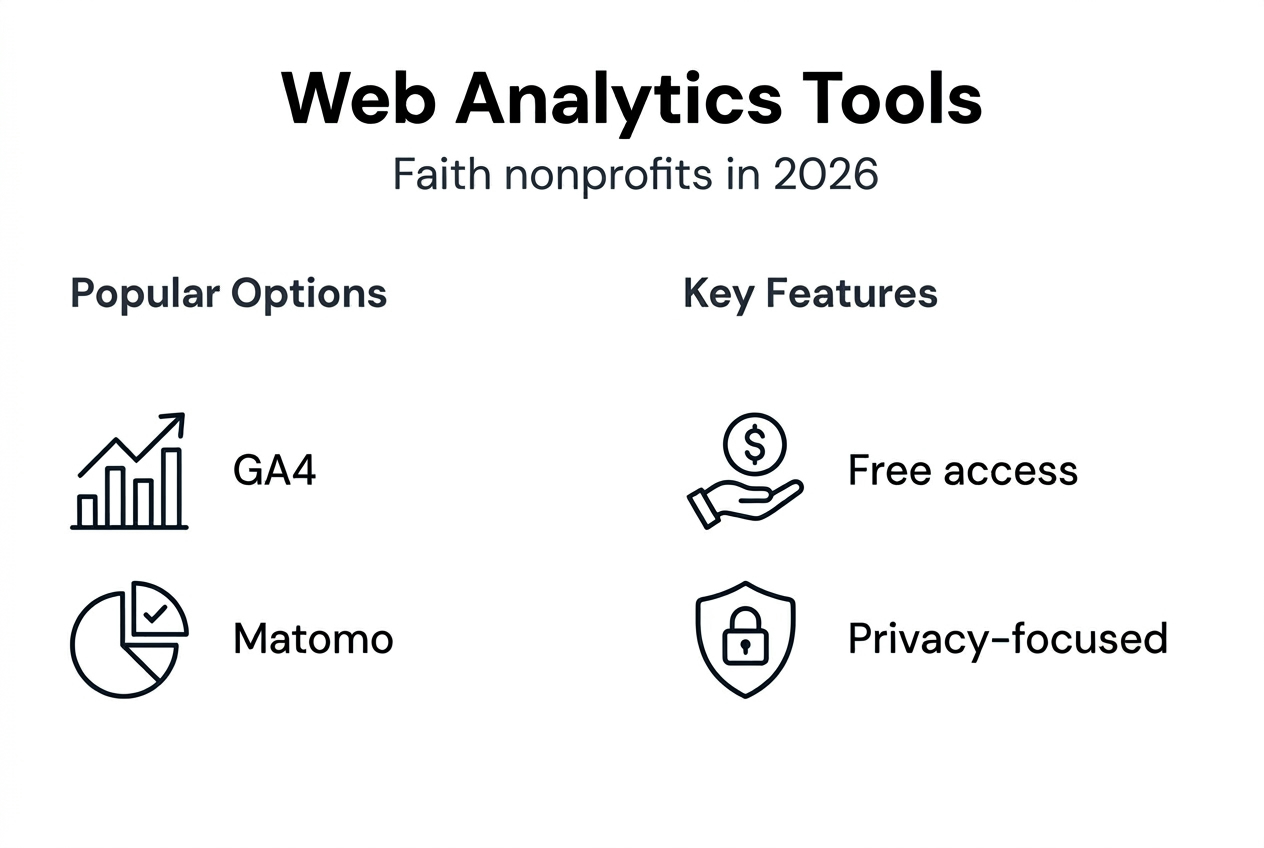
Matomo offers privacy-focused analytics with full data ownership. Unlike GA4, Matomo can be self-hosted, giving complete control over supporter data. This appeals to organizations prioritizing privacy or serving international audiences under strict data regulations. The tradeoff is higher technical requirements for setup and maintenance. Matomo's cloud version simplifies deployment while maintaining privacy advantages.
Charity-specific platforms like Classy Analytics or Kindful integrate fundraising data with web analytics, connecting donation patterns to digital behavior. These tools cost more but provide unified views of supporter engagement across channels. They're ideal for larger nonprofits managing complex donor relationships and multichannel campaigns.
| Platform | Best For | Key Strengths | Considerations |
|---|---|---|---|
| Google Analytics 4 | Most nonprofits seeking free, powerful analytics | Comprehensive features, integration with Google tools, extensive documentation | Steeper learning curve, cloud-only, data shared with Google |
| Matomo | Privacy-conscious organizations | Full data ownership, GDPR compliant, customizable | Requires technical setup, self-hosted version needs server resources |
| Classy Analytics | Fundraising-focused nonprofits | Integrated donation tracking, donor journey mapping | Higher cost, best for organizations already using Classy |
| Simple Analytics | Small ministries wanting ease of use | Extremely simple interface, privacy-friendly, fast setup | Limited advanced features, subscription cost |
Your choice depends on organizational capacity and priorities. A small church plant with limited technical skills should start with Simple Analytics or GA4's basic features. A regional ministry with dedicated staff might leverage Matomo's advanced segmentation. The right tool is the one you'll actually use consistently.
Consider integration needs. If you use WordPress, many analytics plugins simplify setup. Organizations already invested in Microsoft or Salesforce ecosystems should explore native analytics within those platforms. Seamless integration beats powerful features you can't access easily.
Integrating web analytics into holistic digital marketing strategies
Analytics delivers maximum value when embedded into comprehensive marketing strategies rather than treated as isolated reporting. Integration requires aligning data collection with mission goals, defining relevant KPIs, and creating feedback loops that turn insights into action.
Start by connecting analytics to your nonprofit's strategic objectives. If your goal is increasing monthly donors by 30%, identify web metrics that predict that outcome: email signup rates, recurring donation page visits, or engagement with sustainer content. This alignment ensures you measure what matters rather than vanity metrics.
Defining KPIs tailored to nonprofit objectives creates focus:
- Identify your top three organizational priorities for the year (e.g., donor retention, volunteer recruitment, program awareness)
- Select one primary metric for each priority that web analytics can track (e.g., repeat donation rate, volunteer form completions, educational content engagement)
- Establish baseline measurements and realistic improvement targets based on sector benchmarks
- Create a simple monthly dashboard that displays these KPIs with trend lines showing progress
- Schedule quarterly reviews where leadership discusses what data reveals and adjusts strategies accordingly
Making analytics accessible to your team democratizes data-driven decisions. Not everyone needs to navigate complex platforms, but key staff should understand core metrics. Create one-page summaries translating analytics into plain language: "Our blog readers donate 3x more than average visitors, so we're publishing twice weekly." This clarity enables coordinated action.
Regular review cycles transform analytics from reporting to optimization. Monthly check-ins identify emerging patterns: maybe Instagram drives more engaged traffic than Facebook, suggesting reallocation of social media effort. Quarterly deep dives reveal seasonal patterns informing campaign timing. Annual reviews assess whether your digital strategy advances mission goals or needs fundamental changes.
Pro Tip: Pair quantitative analytics with qualitative feedback. Numbers show what supporters do; surveys and conversations reveal why. When analytics shows high bounce rates on your giving page, ask recent donors what almost stopped them from completing their gift. This combination produces breakthrough insights.
Integration extends to your broader digital marketing services ecosystem. Analytics should inform content calendars, email segmentation, social media strategy, and website updates. When data and creativity work together, your digital presence becomes a powerful ministry multiplier.
Conclusion and practical next steps for nonprofit leaders
Web analytics empowers faith-based nonprofits to understand supporter behavior, optimize digital outreach, and increase both donations and mission impact. The evidence is clear: organizations leveraging data see measurably better engagement and conversion rates than those operating on intuition alone.
Starting with clear, mission-aligned goals ensures analytics serves your ministry rather than distracting from it. Define what success looks like, whether that's more online donations, increased event attendance, or deeper content engagement. Let those goals guide which metrics you track and how you interpret results.
Practical first steps include:
- Install Google Analytics 4 or your chosen platform on your website this week if you haven't already
- Identify your single most important conversion goal and configure it in your analytics tool
- Schedule 15 minutes weekly to review your top three metrics and note any significant changes
- Connect with one team member to share analytics insights and discuss implications monthly
Leveraging tools and training accelerates your analytics maturity. Platforms like Google offer free certification courses. Nonprofit technology associations provide sector-specific guidance. Investing a few hours in learning pays dividends for years through smarter digital strategies informed by data-driven marketing nonprofits approaches.
Ongoing review and optimization transform analytics from a one-time project into continuous improvement. Set quarterly goals based on data, test new approaches, and measure results. This cycle of learning and adapting ensures your digital ministry evolves with changing supporter needs and technological opportunities. Use resources like a marketing automation checklist to systematize improvements over time.
Enhance your nonprofit's digital outreach with MCNM
Transforming analytics insights into ministry results requires both technical expertise and strategic vision. MCNM Marketing specializes in helping faith-based nonprofits implement data-driven digital strategies that amplify mission impact and donor engagement.
Our team understands the unique challenges facing ministries and faith nonprofits in 2026. We've helped organizations like yours optimize websites for better conversions, implement marketing automation that nurtures supporter relationships, and build digital outreach systems that expand kingdom work efficiently and effectively.
Whether you need a basic website design that captures supporter data effectively, marketing automation for nonprofits that increases donations, or comprehensive digital outreach nonprofits impact strategies, MCNM provides tailored solutions that align with your mission and budget. We combine AI-powered tools with faith-driven values to help you reach more people and steward resources wisely.
FAQ
What is web analytics and why is it important for faith-based nonprofits?
Web analytics tracks and analyzes website visitor data to understand how supporters interact with your digital presence. For faith nonprofits, this reveals which content resonates, where potential donors abandon their journey, and how to optimize outreach for greater mission impact and improved fundraising results.
Which web analytics metrics should nonprofits prioritize?
Bounce rate, session length, and conversion rate provide the most actionable insights for nonprofits. These metrics reveal engagement quality, content effectiveness, and donation pathway performance, allowing you to focus improvements where they'll deliver the greatest return on your limited resources and staff time.
How can small faith nonprofits afford and use web analytics effectively?
Free tools like Google Analytics 4 offer robust capabilities suitable for organizations of any size. Start with clear goals, track just two or three key metrics initially, and dedicate 15 minutes weekly to review data. This focused approach builds analytics capacity without overwhelming small teams or budgets.
What are common pitfalls when implementing web analytics in nonprofits?
Relying solely on traffic volume while ignoring engagement metrics like conversion rate and session length limits usefulness. Another pitfall is collecting data without connecting it to mission goals, resulting in reports that don't drive decisions. Always align analytics with your strategic objectives and focus on actionable insights.
What's the first step to integrating web analytics into our outreach strategies?
Define clear goals aligned with your mission, such as increasing monthly donors or volunteer signups. Then select two or three KPIs that directly measure progress toward those goals. This foundation ensures your analytics efforts focus on metrics that matter rather than vanity numbers that don't advance ministry impact. Explore data-driven marketing nonprofits resources for detailed implementation guidance.
Recommended
- Optimize your faith nonprofit website with AI in 2026 | AI and Digital Marketing Service by MCNM
- Services | AI and Digital Marketing Service by MCNM
- Automate Marketing: 30% More Donor Engagement in 2026 | AI and Digital Marketing Service by MCNM
- Digital Growth Strategy: Shaping Nonprofit Impact | AI and Digital Marketing Service by MCNM
- ESS IA topics: Surveys and Secondary Data bases - ESS Online tutor