

Reaching the right supporters can feel like searching for a single voice in a crowded room. For faith-driven organizations with limited resources, missed connections and generic outreach waste precious time and energy. Artificial intelligence gives nonprofits a powerful way to personalize engagement, sharpen their message, and act with purpose. This article will help you understand AI’s unique role in modern marketing so your team can serve your mission—and your people—more meaningfully.
Table of Contents
- Defining AI's Role in Modern Marketing
- Core Types of AI Tools and Technologies
- Practical Uses in Faith-Based Outreach
- Risks, Ethics, and Common Pitfalls
- Best Practices for Mission-Driven Adoption
Key Takeaways
| Point | Details |
|---|---|
| AI Enhances Decision-Making | AI provides nonprofits with data-driven insights, enabling faster and more informed decisions regarding donor engagement and outreach. |
| Efficient Resource Management | By automating repetitive tasks, AI allows smaller teams to achieve greater impact without overwhelming their limited resources. |
| Personalized Engagement | AI tailors communication to individual supporters, enhancing relevance and fostering deeper connections with audiences. |
| Ethical AI Use is Crucial | Organizations must prioritize ethical considerations, such as data privacy and algorithmic bias, to maintain trust and uphold their mission. |
Defining AI's Role in Modern Marketing
Artificial intelligence in marketing isn't about replacing human judgment. It's about giving your team the data and tools to make better decisions faster.
At its core, AI transforms how nonprofits and faith-based organizations connect with their audiences. Rather than guessing what donors want or hoping your message lands, AI provides clarity.
What AI Actually Does in Marketing
AI handles the heavy lifting of analysis and personalization. Think of it as hiring someone who never sleeps, never gets frustrated, and processes millions of details in seconds.
Key capabilities include:
- Predictive analytics identify which supporters are most likely to give or engage based on past behavior
- Customer segmentation groups your audience by interests, giving capacity, and engagement level
- Personalized recommendations suggest content or giving opportunities tailored to individual supporters
- Chatbots and automated responses handle common questions 24/7, freeing your team for complex conversations
- Campaign optimization tests different approaches and automatically amplifies what works
Predictive analytics and personalized marketing enable nonprofits to match messages to supporter preferences, increasing both relevance and impact.
Your organization now has visibility into patterns you'd never see manually. A donor who downloads your annual report, attends one event, and opens emails about youth programs becomes a clear candidate for a major gift ask on your youth initiative.

Why This Matters for Mission-Driven Work
Faith-based and nonprofit organizations operate with limited budgets and staff. Every dollar and every volunteer hour must count.
AI closes that efficiency gap. It lets smaller teams achieve results that once required much larger operations. Your volunteer coordinator isn't spending hours sorting emails or manually tagging contacts. Instead, they're having meaningful conversations with supporters.
You reach the right person with the right message at the right time. Not everyone. Not constantly. Just those ready to hear from you.
Your AI doesn't replace your mission or your values. It amplifies them by ensuring your message finds the people who care most.
Beyond Simple Automation
AI isn't just about sending emails automatically. Real AI-driven marketing balances efficiency with human creativity and ethical responsibility in how you engage supporters.
Consider the difference:
- Without AI: You send the same monthly newsletter to 5,000 people. Some unsubscribe. Many don't open it.
- With AI: Your system sends content timing and messaging adjusted for each supporter segment. Young professionals get updates about service opportunities. Major donors receive cultivation materials. Existing volunteers get impact stories.
The second approach respects your supporters' time and attention. It treats them as individuals, not just names on a list.
AI also flags data privacy concerns before they become problems. When your system handles sensitive donor information, proper safeguards aren't optional. AI can monitor data usage, flag concerning patterns, and ensure compliance with regulations that protect supporter privacy.
This matters deeply for faith organizations, where trust is foundational.
Pro tip: Start with one clear goal before implementing AI tools. Whether it's increasing email open rates, identifying lapsed donors, or personalizing welcome experiences, focusing first prevents overwhelm and shows measurable results quickly.
Core Types of AI Tools and Technologies
AI tools for marketing don't all work the same way. Understanding what each type does helps you choose the right tools for your nonprofit's actual needs.
Think of AI capabilities as falling into three distinct buckets. Each solves different problems and requires different implementation approaches.
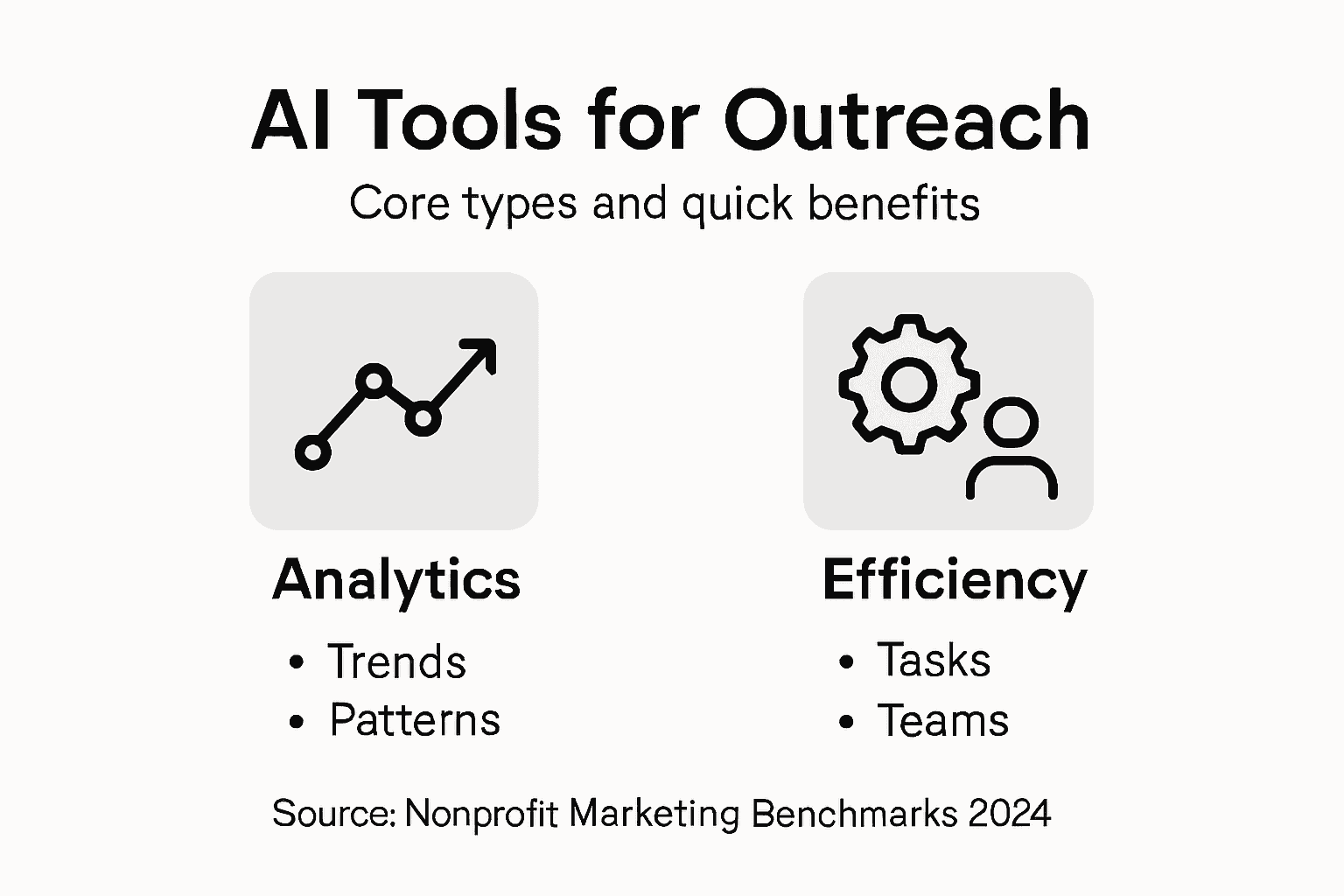
Analytical Marketing Capabilities
This is where AI reads your data and finds patterns you can't see manually. Machine learning and predictive analytics power this category, enabling nonprofits to understand supporter behavior before it happens.
Analytical tools help you:
- Predict which donors will lapse before they actually do
- Identify your most valuable supporter segments by lifetime giving potential
- Forecast campaign response rates based on historical data
- Spot trends in engagement that signal donor readiness for cultivation
Your data becomes actionable intelligence instead of just numbers in a spreadsheet. A nonprofit with 10,000 supporters can instantly identify the 200 most likely to increase their giving.
Here's how the three core types of AI marketing tools compare for nonprofits:
| Capability Type | Main Purpose | Typical Benefit | Example Tool/Application |
|---|---|---|---|
| Analytical | Identify patterns and predict outcomes | Targeted outreach | Donor engagement analysis |
| Technological | Personalize and automate communication | Higher supporter impact | Dynamic email personalization |
| Strategic Efficiency | Streamline operations and save time | Staff bandwidth freed | Automated social scheduling |
Technological Marketing Capabilities
These are the automation and personalization engines. They take insights from analytics and apply them in real time across your supporter touchpoints.
Key technologies include:
- Natural language processing powers chatbots that understand supporter questions and respond appropriately
- Email personalization systems adjust subject lines, content, and send times for each individual
- Dynamic content delivery shows different website sections to different visitors based on interests
- Automated lead scoring prioritizes which prospects your team should contact first
These tools transform one-size-fits-all communications into individual conversations at scale. Your welcome email for a young professional looks different from one sent to a retired executive.
Strategic Efficiency Capabilities
These tools handle the busywork so your team focuses on relationship-building. They optimize operations and free up human capacity for high-touch work.
Applications include:
- Scheduling social media posts across multiple platforms
- Automating follow-up sequences after events
- Organizing contact data and maintaining clean databases
- Generating performance reports and identifying optimization opportunities
The most successful nonprofits use all three categories together, not just one in isolation. Analytics informs strategy, technology delivers it, and efficiency tools buy back staff time.
Many nonprofits start with strategic efficiency tools because they see immediate time savings. That's smart. But pairing them with analytical capabilities means those saved hours go toward meaningful supporter conversations, not just checking boxes.
Pro tip: Start by auditing which repetitive tasks consume the most staff hours, then find AI tools addressing those specific bottlenecks—this creates measurable ROI fastest and builds internal support for broader AI adoption.
Practical Uses in Faith-Based Outreach
AI isn't abstract for faith organizations. It's showing up in real churches, ministries, and faith-based nonprofits solving everyday problems right now.
The best part? These applications align with core faith values while freeing leaders to do what they do best: pastor people.
Personalized Spiritual Guidance and Engagement
Machine learning algorithms can analyze individual supporter interests and suggest relevant content. A donor who frequently opens emails about youth ministry gets updates about your youth programs. Someone engaged with community service receives opportunities to serve.
Personalized spiritual guidance powered by AI increases engagement because it respects people's existing interests rather than treating everyone the same.
Practical applications include:
- Recommending relevant sermon content based on supporter questions or interests
- Suggesting volunteer roles that match individual skills and passion areas
- Matching mentorship pairs within your congregation based on life stage and experience
- Sending targeted invitations to events aligned with each person's giving history
Your supporters feel seen. They receive communications that genuinely matter to them, not generic blasts.
Administrative Efficiency and Pastoral Care
Here's where AI really frees up leader bandwidth. Churches are using AI to streamline scheduling, handle administrative tasks, and improve communication efficiency, allowing pastors to focus on discipleship and spiritual care.
Common uses include:
- Automating volunteer scheduling across multiple ministry teams
- Managing event registrations and follow-up communications
- Organizing prayer requests and connecting intercessors to specific needs
- Generating first drafts of routine announcements and communications
- Tracking discipleship progress and flagging people who need check-ins
Your senior pastor isn't spending Tuesday mornings on scheduling. They're having coffee with someone wrestling with faith questions.
Community Sentiment and Needs Assessment
AI can analyze feedback from surveys, conversations, and social media to understand what your congregation actually needs. Sentiment analysis shows whether people feel connected, supported, or struggling.
AI tools reveal congregation needs before you ask. This helps leaders address real pain points, not assumed ones.
This approach respects congregational dignity. You're listening to what people actually say they need, not imposing programs based on what leadership thinks they should need.
One ministry discovered through sentiment analysis that single parents felt isolated during family-focused services. They launched targeted small groups addressing that exact gap. The data pointed to a real problem their leaders hadn't noticed.
Pro tip: Start with one small automation task your team does repeatedly each month, track the time freed up, then calculate actual staff hours recovered to justify expanding AI adoption to leadership and board members.
Risks, Ethics, and Common Pitfalls
AI is powerful. Power always comes with responsibility. Before implementing AI in your nonprofit, understand the real risks and ethical pitfalls that organizations encounter.
This isn't fear-mongering. It's realism. The better you understand potential problems, the better you can prevent them.
Algorithmic Bias and Unfair Targeting
AI systems learn from historical data. If your past data reflects bias, your AI will amplify it. This happens accidentally, not maliciously.
Example: If your organization historically reached wealthy donors, your AI might systematically deprioritize outreach to lower-income supporters. The algorithm learns what worked before and doubles down on it.
Algorithmic bias in AI marketing can exclude entire communities from knowing about your mission. This contradicts most faith organizations' commitment to inclusion and equity.
Prevention steps:
- Audit your historical data for obvious patterns before feeding it to AI systems
- Monitor AI recommendations for demographic skew over time
- Deliberately include underrepresented communities in your outreach
- Test different supporter segments to ensure fair treatment
Data Privacy and Supporter Trust
You're handling sensitive information: donor names, giving history, prayer requests, family situations. When AI processes this data, breaches become catastrophic.
Faith communities especially demand trust. One data scandal destroys years of relationship-building.
Real risks include:
- Storing sensitive data on servers you don't fully control
- Third-party AI tools accessing more data than necessary
- Inadequate encryption leaving supporter information vulnerable
- Poor access controls allowing staff to view confidential information unnecessarily
Your responsibility: Know exactly where your data lives and who can access it.
This table highlights key ethical risks and solutions for AI adoption in nonprofit marketing:
| Ethical Concern | What Can Go Wrong | Prevention Strategy |
|---|---|---|
| Algorithmic Bias | Excludes some supporter groups | Audit input data and monitor outcomes |
| Data Privacy | Leaks sensitive information | Use strong encryption and access controls |
| Manipulation | Unethical influence tactics | Maintain human review for messaging |
| Job Displacement | Decreased staff morale | Retrain staff for higher-impact roles |
Manipulation and Authentic Engagement
AI can optimize for clicks and opens. But optimizing for engagement isn't the same as respecting supporter autonomy.
Sending the perfect email at the perfect moment to trigger a donation? That's persuasion. Doing it based on psychological vulnerabilities AI detected? That's manipulation.
Effective ministry respects free will. AI should amplify authentic connection, not manufacture artificial urgency.
Faith organizations should ask: Are we helping people make informed decisions, or are we exploiting psychological triggers?
Job Displacement and Staff Morale
When you automate tasks, staff worry about job security. Address this head-on.
The healthiest AI implementation doesn't eliminate positions. It redirects hours toward higher-impact work. Your administrative coordinator stops handling registration emails and starts organizing volunteer training. That's growth, not elimination.
Communicate clearly with your team about what's changing and why. Include them in choosing which tasks get automated. Staff who feel heard become AI champions instead of resistors.
Accountability and Decision-Making
When AI makes recommendations, who takes responsibility if something goes wrong? This murky accountability creates real problems.
Never let AI make final decisions about major donor relationships, discipleship pathways, or resource allocation. Humans must review and approve. The AI suggests; your team decides.
Pro tip: Create a simple AI governance checklist addressing data privacy, bias monitoring, and decision authority before implementing any new tool, then require board or leadership sign-off on your AI practices.
Best Practices for Mission-Driven Adoption
Adopting AI doesn't mean abandoning your values. The organizations getting real results treat AI as a tool serving their mission, not the other way around.
These practices separate successful implementations from costly mistakes.
Start With Mission Alignment, Not Technology
This is backward from what most organizations do. They find cool AI tools, then figure out how to use them.
Instead: Define your mission outcome first. Then ask which AI capabilities actually serve that outcome.
Example: If your mission is serving homeless populations, you might deploy AI for volunteer scheduling efficiency. You probably shouldn't use facial recognition to track attendees.
Best practices for AI adoption emphasize mission alignment and ethical considerations as foundational to sustainable implementation. When AI supports your core values, staff adoption accelerates and donors trust your approach.
Start with these questions:
- What outcome does your mission require?
- Which repetitive tasks prevent your team from achieving it?
- Can AI genuinely help with those tasks?
- Does AI accomplish this without compromising your values?
If you can't answer yes to all four, keep looking.
Build Organizational Readiness First
Technology fails without the right foundation. Your team needs training, clear communication, and leadership buy-in before implementation.
Organizational readiness includes:
- Board and leadership agreement on AI strategy and governance
- Staff training on how AI tools work and what they can't do
- Clear communication about why you're adopting AI (not "we're replacing people")
- Data quality assessment and cleanup before feeding data to AI systems
- Documented processes for how AI recommendations get reviewed and approved
Skipping these steps leads to underused tools and staff resistance. A $5,000 tool sits dormant if your team doesn't trust it or understand its purpose.
Maintain Human Oversight in Everything That Matters
Selective AI deployment maintaining human oversight in critical applications preserves organizational sovereignty and mission integrity. This means humans review final decisions about donor relationships, volunteer assignments, and resource allocation.
AI can flag which donors might increase giving. Your relationship manager decides the approach. AI suggests volunteer roles matching skills. Your coordinator makes the match.
This partnership approach respects both AI's analytical power and human judgment's irreplaceable value.
Never let AI make unreviewed decisions about people. The moment you do, you've surrendered control of your mission.
Invest in Ongoing Ethical Training
AI bias and ethics aren't one-time training. They require continuous attention as your organization grows and data changes.
Your team needs regular discussion about:
- How to spot potential bias in AI recommendations
- What data privacy means for your specific context
- When AI recommendations should be questioned or overridden
- New risks emerging as you use AI in new ways
Treat ethical training like financial audits: essential maintenance, not optional.
Pro tip: Select one small pilot project aligned closely with your mission, measure results over 90 days, then present findings to leadership and staff before scaling adoption further.
Amplify Your Mission Outreach with AI-Driven Marketing Solutions
The article highlights the challenge faith-based and nonprofit organizations face in personalizing outreach while managing limited resources. AI offers powerful tools like predictive analytics and marketing automation to enhance supporter engagement and optimize campaigns. Yet, without the right technology partner, these advancements can feel overwhelming or misaligned with your mission and values.
At MCNM Marketing, we understand your need for secure, ethical, and purpose-led digital growth. Our faith-driven agency specializes in AI-powered marketing automation and WordPress website development crafted to support nonprofits and ministries. We help you harness AI for:
- Personalized email marketing that respects supporter interests
- Streamlined volunteer and donor management processes
- Data-driven outreach strategies that amplify your impact
Take the first step toward mission-focused digital transformation. Explore how our comprehensive services can free your team to focus on what matters most while expanding your outreach with confidence. Visit MCNM Marketing to learn more and start your journey today. See how aligning AI tools with your mission can transform your engagement efforts and bring measurable results.
Frequently Asked Questions
How does AI improve donor engagement in nonprofit marketing?
AI enhances donor engagement by analyzing past behaviors and personalizing communication. Through predictive analytics, organizations can identify which supporters are most likely to give, ensuring that they receive tailored content and relevant opportunities.
What types of AI tools are most effective for nonprofits?
Nonprofits benefit from three main types of AI tools: analytical capabilities for identifying patterns, technological capabilities for personalizing and automating communication, and strategic efficiency tools that streamline operations and save staff time.
How can AI help improve the effectiveness of marketing campaigns?
AI can optimize marketing campaigns by testing different messaging strategies, automating responses, and personalizing content based on individual supporter interests. This results in more relevant outreach, ultimately increasing engagement and donations.
What ethical considerations should nonprofits keep in mind when using AI?
Nonprofits should be aware of potential algorithmic bias, data privacy concerns, and the need for human oversight. Regular audits of data and ongoing ethical training are important to ensure that AI systems align with organizational values and maintain supporter trust.
Recommended
- From Efficiency to Effectiveness: Generative AI’s New Role in Digital Marketing | AI and Digital Marketing Service by MCNM
- AI Tools for Small Business Growth in 2025 | AI and Digital Marketing Service by MCNM
- AI‑Free Branding and Human‑AI Collaboration: Finding the Right Balance | AI and Digital Marketing Service by MCNM
- Purpose-Driven Marketing Automation Guide for Nonprofits | AI and Digital Marketing Service by MCNM
- Marketing Insights & SEO News | HYPED