

Many faith-based nonprofits mistakenly treat content strategy as just churning out blog posts and social media updates. This narrow view leaves mission alignment and engagement potential untapped. Content strategy is actually a comprehensive framework that plans, creates, distributes, and measures content to directly support your organization's mission and connect authentically with your community. This guide clarifies what content strategy truly involves and shows you how to implement it effectively.
Table of Contents
- Understanding content strategy and its importance
- Mission alignment through content strategy
- Frameworks for effective content strategy
- Integrating AI and automation in content strategy
- Common misconceptions and pitfalls
- Comparison of content distribution channels
- Measuring and optimizing content impact
- Enhance your nonprofit's content strategy with MCNM services
Key takeaways
| Point | Details |
|---|---|
| Content strategy aligns content with mission | Deliberate planning ensures every piece reflects organizational values and drives engagement. |
| Effective strategy covers four stages | Plan, create, distribute, and measure content for maximum impact. |
| AI and automation enhance personalization | Technology optimizes outreach timing and messaging while maintaining authentic connection. |
| Avoid common pitfalls | Neglecting distribution and measurement undermines even quality content. |
| Measurement drives improvement | Tracking engagement and conversion metrics reveals what resonates with your community. |
Understanding content strategy and its importance
Content strategy defines the why, who, and how of content creation, ensuring it serves mission-related goals and tailored audience needs rather than just publishing content. For faith-based nonprofits, this strategic approach transforms random content efforts into a cohesive communication system that reinforces your mission with every post, email, and webpage.
Unlike commercial brands focused purely on sales, your organization needs content that builds trust, inspires action, and nurtures long-term relationships with donors, volunteers, and community members. Content strategy addresses unique nonprofit challenges like limited budgets, volunteer-driven teams, and the need to communicate complex spiritual and social missions clearly.
A robust content strategy includes four essential components:
- Purpose: Clear objectives tied to mission outcomes like increased donations, volunteer sign-ups, or community awareness
- Audience: Deep understanding of donor motivations, community needs, and spiritual journeys
- Channels: Strategic selection of platforms where your audience actively engages
- Measurement: Data-driven evaluation of what content drives meaningful action
Many nonprofits excel at creating heartfelt stories but struggle with distribution and optimization. Your content creation guide nonprofit impact efforts only succeed when paired with strategic planning that ensures the right people see your message at the right time. This holistic view separates content strategy from simple content production.
Pro Tip: Start by auditing existing content to identify gaps between what you publish and what your mission requires. This reveals opportunities to better serve your community.
Integrating content strategy into your broader digital strategy marketing framework ensures every digital touchpoint reinforces your mission and moves people toward deeper engagement.
Mission alignment through content strategy
Mission-aligned content creates authentic connections that generic marketing never achieves. When your digital presence consistently reflects core values and organizational narratives, you build trust that translates into sustained donor engagement and community loyalty. Faith-based audiences especially value this authenticity, as they seek organizations whose actions match their stated beliefs.
Content aligned with your mission accomplishes several critical goals:
- Reinforces organizational identity across all communication channels
- Attracts supporters who share your values and vision
- Provides clear evidence of impact that resonates emotionally
- Differentiates your nonprofit in a crowded charitable landscape
Consider a homeless ministry that shares weekly stories of individuals rebuilding their lives through faith-based programs. This content directly reflects their mission of restoration and dignity. Each story demonstrates impact while inviting supporters into the transformation process. The strategic repetition of mission themes across blog posts, emails, and social media creates a cohesive narrative that donors recognize and trust.
"Organizations that consistently communicate their mission through strategic content see 67% higher donor retention rates compared to those with inconsistent messaging."
Your digital outreach nonprofits impact expands when content strategy ensures every piece advances mission objectives. Storytelling grounded in your values creates emotional connections that statistics alone cannot achieve. Share testimonials from beneficiaries, behind-the-scenes glimpses of programs, and transparent updates on challenges and victories.

Mission alignment also means knowing what not to say. Content that chases trends or imitates corporate marketing dilutes your unique voice. Stay focused on the transformation your organization creates and the faith principles that guide your work.
Frameworks for effective content strategy
Structured frameworks prevent the chaos of reactive content creation and ensure strategic use of limited nonprofit resources. The content lifecycle framework provides a proven model: Plan, Create, Distribute, Measure. Each stage builds on the previous one to maximize content impact and resource efficiency.
Implementing this framework for faith-based nonprofits involves adapting each stage to mission priorities:
- Plan: Define content goals tied to mission outcomes, research audience needs, and map content to the donor journey
- Create: Develop mission-aligned content that tells authentic stories and addresses community questions
- Distribute: Share content through channels where your audience actively engages, from email to social platforms
- Measure: Track metrics that matter like engagement rates, donation conversions, and volunteer sign-ups
This cyclical approach means measurement insights inform future planning, creating continuous improvement. Many nonprofits skip straight to creation without planning or never circle back to measure results. Breaking this pattern dramatically improves content ROI.
| Lifecycle Stage | Key Activities | Expected Outcomes |
|---|---|---|
| Plan | Audience research, goal setting, content calendar creation | Clear roadmap aligned with mission and resources |
| Create | Storytelling, visual design, copywriting | Quality content that resonates emotionally |
| Distribute | Email campaigns, social posting, website updates | Maximum reach to target audience segments |
| Measure | Analytics review, A/B testing, performance reports | Data-driven insights for optimization |
Frameworks also help volunteer teams and small staffs work more efficiently. A documented content process reduces decision fatigue and ensures consistency even when team members change. Your digital strategy marketing becomes more sustainable with repeatable systems.
Pro Tip: Start small by implementing the framework for one content type like monthly email newsletters before expanding to all channels.
Adapting proven frameworks to your specific context prevents reinventing the wheel while maintaining mission authenticity. The structure provides guardrails that keep content efforts focused and measurable.
Integrating AI and automation in content strategy
AI-powered tools revolutionize how faith-based nonprofits personalize communication and optimize engagement without requiring large marketing teams. Automation handles repetitive tasks like email scheduling and audience segmentation, freeing staff to focus on relationship building and strategic decisions. When implemented thoughtfully, technology enhances rather than replaces the human connection central to nonprofit work.
AI improves content effectiveness through several practical applications:
- Personalized email timing: Algorithms identify when individual donors most likely open messages, increasing engagement
- Content recommendations: Systems suggest relevant articles or resources based on past interactions
- Predictive analytics: AI identifies donors at risk of lapsing so you can re-engage them proactively
- Automated segmentation: Technology groups supporters by interests, giving history, or engagement level for targeted messaging
A youth ministry using AI-powered email automation saw open rates jump from 18% to 34% by sending messages at optimal times for each subscriber. The same organization automated welcome sequences for new website visitors, nurturing them from curious browser to committed volunteer without manual intervention.
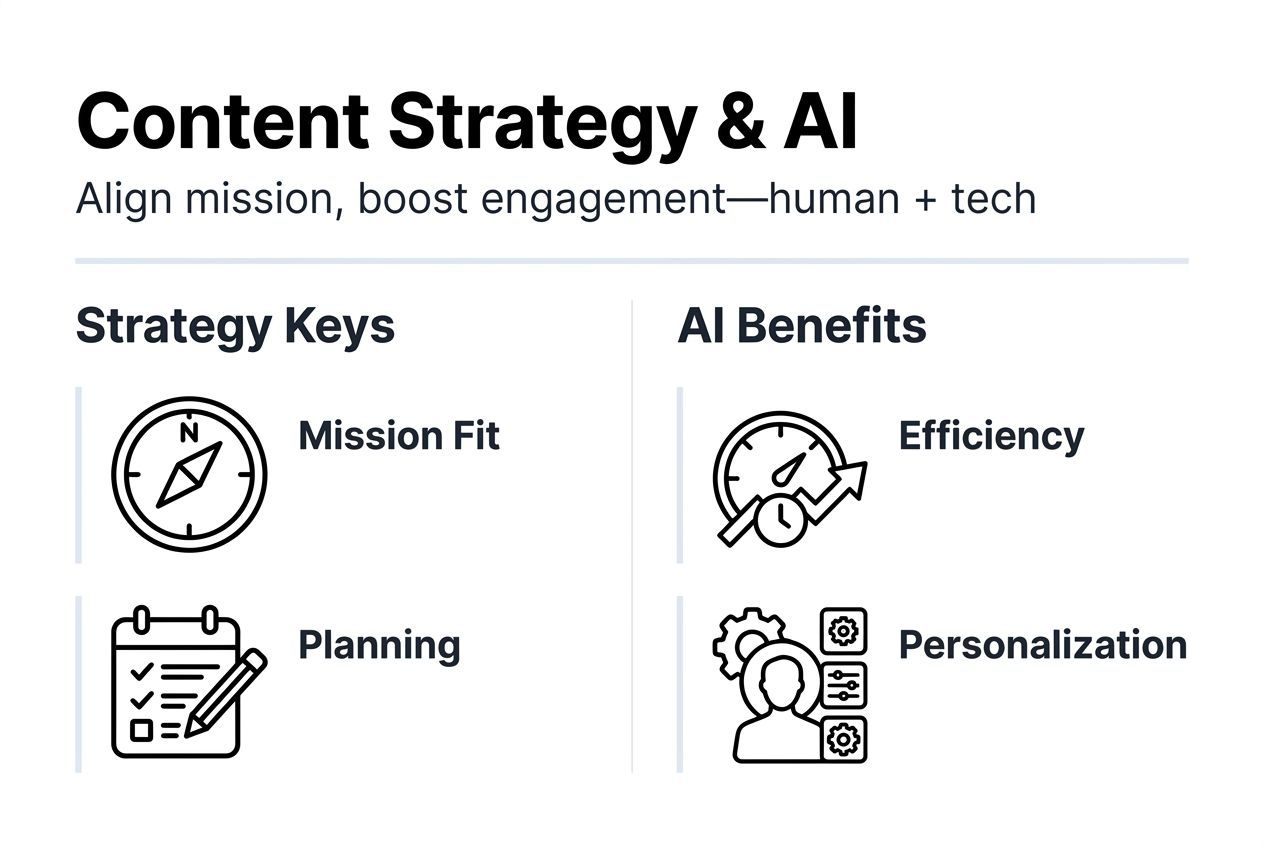
The role of AI in marketing extends beyond efficiency to enhance personalization at scale. You can deliver relevant content to thousands of supporters as if speaking to each individually. This level of customization was previously impossible for resource-limited nonprofits.
Pro Tip: Balance automation with authentic human touch by using AI for delivery optimization while maintaining personal voice in actual content creation.
Marketing automation platforms let you automate marketing donor engagement by triggering content based on specific actions like attending an event or making a first donation. These systems work 24/7 to nurture relationships while your team focuses on high-impact activities.
The key is using technology to amplify your mission message, not replace authentic storytelling. AI handles logistics and optimization so humans can focus on crafting compelling narratives that inspire action.
Common misconceptions and pitfalls
Faith-based organizations often mistakenly treat content strategy as solely content creation, overlooking critical elements like audience analysis, distribution, and measurement. This narrow perspective leads to wasted effort creating content that never reaches the right people or drives meaningful action. Understanding and avoiding these misconceptions dramatically improves content effectiveness.
The most damaging myths include:
- More content always equals better results: Quality mission-aligned content that resonates emotionally outperforms high-volume generic posts every time
- Social media reach happens organically: Algorithms limit organic visibility, requiring strategic paid promotion or email distribution for reliable reach
- Creation is the hard part: Distribution and promotion often require more effort and strategy than initial content development
- One size fits all audiences: Different supporter segments need tailored messaging that speaks to their specific motivations and interests
A common pitfall is investing heavily in blog content without promotion strategy. Your thoughtfully crafted articles sit unread because you assumed people would find them through search engines alone. Effective distribution requires active promotion through email, social media, partner organizations, and paid channels when appropriate.
"Over 60% of nonprofits create content without documented distribution strategies, severely limiting potential impact and wasting valuable resources."
Another frequent mistake is neglecting measurement entirely. Without tracking what content drives donations, volunteer sign-ups, or event attendance, you cannot identify what works or optimize future efforts. Even basic analytics reveal patterns that inform smarter content decisions.
Some organizations also confuse activity with progress. Publishing daily social posts feels productive but means nothing if those posts do not advance mission goals or engage your community meaningfully. Strategic focus on fewer, higher-impact pieces often delivers better results than constant publishing.
Your content creation guide nonprofit impact efforts multiply when you avoid these pitfalls and embrace comprehensive strategy over simple production.
Comparison of content distribution channels
Choosing the right mix of distribution channels determines whether your carefully crafted content reaches and resonates with your target audience. Each channel offers distinct advantages and limitations that faith-based nonprofits must weigh against mission priorities and resource constraints. Strategic channel selection ensures maximum return on content investment.
| Channel Type | Engagement Level | Conversion Rate | Control | Cost |
|---|---|---|---|---|
| Owned Media (Email, Website) | High | Highest (4-6%) | Complete | Low |
| Social Media (Organic) | Medium | Low (1-2%) | Limited | Low |
| Paid Social Ads | Variable | Medium (2-3%) | Moderate | Medium-High |
| Content Partnerships | High | Medium (3-4%) | Shared | Low-Medium |
Owned media like email newsletters and your website provide the highest donor conversion rates because you control the experience and reach people who already expressed interest. Email especially allows personalized messaging and clear calls to action without algorithm interference. Your website serves as the central hub where all other channels drive traffic.
Social media expands reach to new audiences but offers less control and lower conversion rates. Platform algorithms determine who sees your content, often requiring paid promotion to reach even existing followers. However, social channels excel at community building and sharing visual stories that inspire emotional connection.
Key factors for channel selection include:
- Audience presence: Where do your donors and community members actively spend time?
- Content format fit: Does the channel support your preferred storytelling methods like video, long-form articles, or quick updates?
- Resource requirements: Can you consistently create content optimized for this platform?
- Mission alignment: Does the channel's culture and user expectations match your organizational values?
Most effective strategies combine owned, earned, and paid channels. Use social media to build awareness and community, email to nurture relationships and drive action, and your website as the conversion-optimized destination. Strategic nonprofit digital marketing strategies integrate multiple channels for comprehensive reach.
Do not spread resources too thin by trying to maintain presence on every platform. Focus on two to three channels where your audience concentrates and you can deliver consistent, quality content.
Measuring and optimizing content impact
Data-driven measurement transforms content strategy from guesswork into a systematic approach that continuously improves results. Tracking the right metrics reveals what resonates with your community, which channels drive action, and where to focus limited resources for maximum mission impact. Without measurement, you cannot optimize or demonstrate value to stakeholders.
Essential metrics for faith-based nonprofits include:
- Engagement metrics: Email open rates, click-through rates, social shares, and time on page indicate content relevance
- Conversion metrics: Donation completions, volunteer sign-ups, and event registrations show content effectiveness at driving action
- Retention metrics: Repeat donor rates, email list growth, and sustained engagement reveal relationship strength
- Reach metrics: Website traffic, social followers, and email list size measure audience expansion
Google Analytics provides free website tracking including traffic sources, popular content, and user behavior patterns. Email platforms like Mailchimp offer built-in analytics showing open rates, clicks, and conversion tracking. Social media platforms provide native analytics on post performance and audience demographics.
Use measurement insights to make informed content decisions. If donation appeal emails sent on Thursday afternoons consistently outperform Monday mornings, adjust your schedule. When blog posts about program impact generate more engagement than organizational updates, create more impact stories. Data removes guesswork from content planning.
Set up regular review cycles to analyze performance. Monthly reviews identify immediate optimization opportunities while quarterly reviews reveal longer-term trends. Share insights with your team and board to demonstrate content ROI and inform strategic decisions.
A food bank discovered through analytics that recipe content featuring donated ingredients drove 40% more website traffic and volunteer applications than general mission updates. This insight led them to expand their recipe content series, directly supporting both community service and volunteer recruitment goals.
Your digital strategy marketing improves through continuous testing and optimization. Try different subject lines, content formats, publishing times, and calls to action. Track results and double down on what works while eliminating what does not.
Measurement also creates accountability to your mission. When you track how content contributes to goals like increased donations or community awareness, you can demonstrate stewardship of resources and make data-backed requests for support.
Enhance your nonprofit's content strategy with MCNM services
Implementing the comprehensive content strategy outlined in this guide requires the right tools and expertise. MCNM Marketing specializes in empowering faith-based nonprofits with AI-powered solutions designed specifically for your unique mission and resource constraints.
Our marketing automation for nonprofits services help you implement the personalization and efficiency strategies discussed here, boosting donor engagement by up to 33%. We build WordPress websites through our basic website design services that serve as optimized content hubs aligned with your mission. Explore our MCNM digital marketing shop for AI tools and resources that make sophisticated content strategy accessible to organizations of any size. Let us help you transform content from random posts into a strategic system that advances your mission and deepens community engagement.
FAQ
What is content strategy for faith-based nonprofits?
Content strategy involves planning and managing digital content to support your mission and engage your faith community effectively. It ensures messages align with organizational values while driving measurable outcomes like donations and volunteer participation.
How can AI improve my nonprofit's content engagement?
AI personalizes communication by optimizing send times and tailoring messages to individual interests, increasing email open rates and donations. It automates routine distribution tasks, freeing your team to focus on relationship building and strategic creative work.
What are common mistakes to avoid when developing a content strategy?
Treating content strategy as only creation without planned distribution or measurement severely limits impact. Focusing on content quantity over mission-aligned quality dilutes your message. Neglecting to analyze results and adjust based on data prevents optimization and wastes valuable resources.
Which content distribution channels work best for my nonprofit?
Owned media like email and your website offer the highest donor conversion rates and complete message control. Social media expands reach but with lower conversions. Use a strategic combination based on where your specific audience engages and what your mission priorities require.
Recommended
- Content Creation Guide for Maximizing Nonprofit Impact | AI and Digital Marketing Service by MCNM
- Digital Strategy & Marketing | AI and Digital Marketing Service by MCNM
- Why Use Content Automation for Nonprofits | AI and Digital Marketing Service by MCNM
- 5 nonprofit digital marketing strategies boosting donations 42% | AI and Digital Marketing Service by MCNM
- Taal Leer: Effectieve Strategieën voor Succesvol Talenonderwijs - Bogaers Taleninstituut Tilburg