

Every faith-based organization knows the challenge of turning meaningful vision into measurable progress. Aligning marketing goals with your mission offers clarity and builds accountability that drives real change. By connecting your core values to strategic objectives and integrating purpose-driven marketing automation tools, you'll discover practical steps to amplify your outreach and deepen supporter engagement. This guide shows how you can move beyond manual tasks and unlock new levels of efficiency, personal connection, and lasting impact.
Table of Contents
- Step 1: Define mission-aligned marketing goals
- Step 2: Select and set up AI-powered automation tools
- Step 3: Design targeted and automated outreach flows
- Step 4: Integrate analytics to optimize engagement
- Step 5: Test and refine automation for maximum impact
Quick Summary
| Key Point | Explanation |
|---|---|
| 1. Define mission-aligned goals | Establish clear marketing objectives that reflect your nonprofit's mission for effective strategies and community impact. |
| 2. Implement AI-powered tools | Utilize AI automation tools to enhance marketing efficiency, streamline tasks, and improve supporter engagement. |
| 3. Create automated outreach flows | Design targeted communication sequences to engage supporters meaningfully and consistently across multiple channels. |
| 4. Integrate analytics for insights | Use analytics to track engagement metrics, enabling data-driven decisions that optimize marketing strategies. |
| 5. Continuously test and refine | Regularly evaluate and adjust automation workflows to improve performance and maintain alignment with organizational goals. |
Step 1: Define mission-aligned marketing goals
Defining clear, meaningful marketing goals that authentically represent your nonprofit's mission is the foundational step in creating purpose-driven marketing strategies. This process ensures every marketing effort contributes directly to advancing your organization's core objectives and creating meaningful community impact.
To establish mission-aligned marketing goals, nonprofits must create strategic objectives connecting mission to measurable outcomes. The methodology involves several critical components:
- Analyze your mission statement: Carefully review your organization's primary purpose and core values
- Identify specific impact metrics: Determine concrete ways to measure progress toward your mission
- Develop SMART objectives: Create goals that are Specific, Measurable, Achievable, Relevant, and Time-bound
Successful mission alignment requires translating broad organizational aspirations into actionable marketing strategies. This means connecting every marketing initiative directly back to your nonprofit's fundamental purpose and measurable impact goals.
A mission-aligned marketing goal transforms abstract vision into concrete, trackable progress toward meaningful community change.
When developing these goals, focus on creating objectives that demonstrate clear connections between marketing activities and your nonprofit's broader mission. This approach ensures marketing becomes a strategic tool for driving organizational impact, not just a peripheral function.

Pro tip: Conduct quarterly reviews of your marketing goals to ensure continuous alignment with your evolving mission and community needs.
Step 2: Select and set up AI-powered automation tools
Selecting and implementing AI-powered automation tools can transform your nonprofit's marketing effectiveness, enabling more efficient and impactful communication strategies. These tools help streamline repetitive tasks while providing sophisticated insights into supporter engagement and fundraising potential.
When evaluating AI automation solutions, nonprofits should focus on marketing automation tools designed for organizational needs. Key considerations include:
- Assess organizational capacity: Understand your team's technical skills and bandwidth
- Define specific marketing objectives: Identify precise goals for automation
- Compare tool features: Evaluate platforms offering nonprofit pricing and scalability
- Check integration capabilities: Ensure tools work seamlessly with existing systems
Choosing the right AI tools requires careful analysis of your nonprofit's unique requirements. Generative AI and predictive analytics tools can provide powerful capabilities for content creation, donor behavior prediction, and targeted communication strategies.
Effective AI automation transforms marketing from a manual process into a strategic, data-driven approach that amplifies your mission's reach.
Successful implementation involves gradual integration, starting with pilot programs and expanding based on measurable outcomes. This approach allows your team to adapt and optimize tools without overwhelming existing workflows.
Pro tip: Schedule quarterly reviews of your AI automation tools to ensure they continue meeting your evolving organizational needs and delivering meaningful impact.
Compare the impact of manual vs. AI-powered marketing automation:
| Approach | Efficiency | Personalization | Scalability |
|---|---|---|---|
| Manual | Time-consuming | Limited tailoring | Hard to expand |
| AI-powered | Highly efficient | Dynamic, data-based | Easily scalable |
Step 3: Design targeted and automated outreach flows
Creating strategic, personalized outreach flows transforms how nonprofits communicate with supporters, enabling more meaningful and efficient engagement. By designing automated communication sequences, you can nurture relationships and maintain consistent connections with different audience segments.
Successful outreach design begins with mapping supporter journeys and segmentation strategies. Key elements include:
- Identify supporter personas: Develop detailed audience segments based on engagement levels
- Create trigger-based workflows: Design automated responses for specific supporter actions
- Personalize communication paths: Tailor messaging to individual supporter interests
- Establish multi-channel touchpoints: Integrate email, social media, and direct communication
Designing effective outreach requires understanding supporter behavior and customizing messaging to maximize engagement. This approach allows nonprofits to deliver relevant content that resonates with each unique supporter group.
Automated outreach transforms sporadic interactions into consistent, meaningful donor relationships.
Implementation involves carefully mapping communication sequences that respond dynamically to supporter interactions. This strategy ensures your messaging remains relevant, timely, and aligned with your organization's mission.
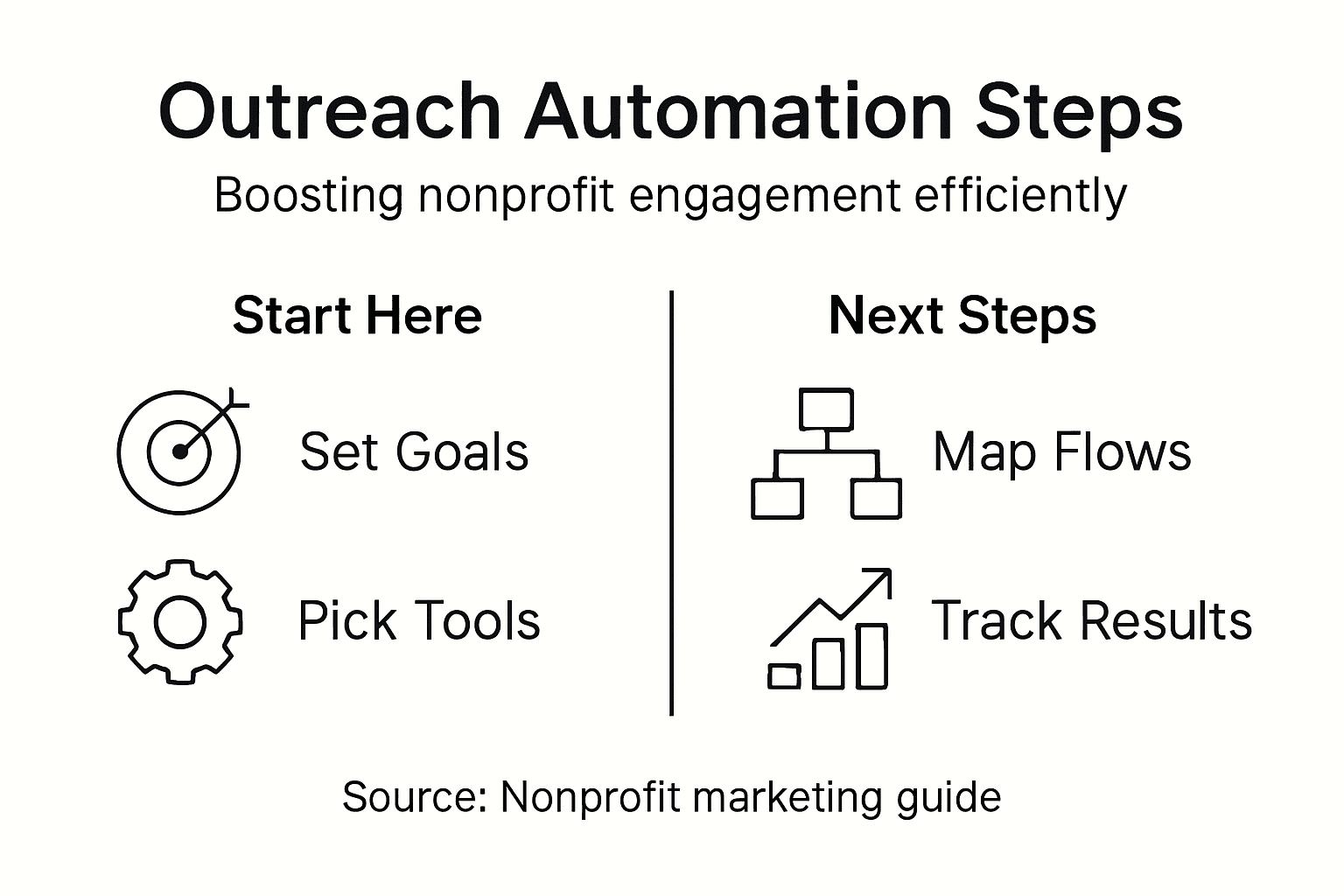
Pro tip: Regularly analyze and refine your automated outreach flows by tracking engagement metrics and supporter response rates to continuously improve communication effectiveness.
Step 4: Integrate analytics to optimize engagement
Analytics integration is the critical engine that transforms raw data into actionable insights for nonprofits, enabling sophisticated understanding of supporter interactions and campaign performance. By systematically tracking and interpreting engagement metrics, your organization can make data-driven strategic decisions that amplify mission impact.
Successful analytics integration involves tracking key performance metrics across communication channels. Essential elements include:
- Identify core engagement metrics: Track email open rates, click-throughs, donation conversions
- Establish baseline performance indicators: Create benchmarks for measuring future progress
- Configure automated reporting systems: Set up dashboards that provide real-time insights
- Develop continuous improvement protocols: Regularly review and adjust strategies based on data
Strategic measurement supports mission-driven decision making by revealing audience behavior patterns and organizational effectiveness. This approach transforms analytics from a passive reporting tool into an active strategy development mechanism.
Data-driven insights turn supporter interactions into strategic opportunities for meaningful engagement.
Implementation requires a holistic approach that views analytics as an ongoing dialogue with your supporter base. By listening closely to the stories told through metrics, nonprofits can continuously refine their communication and outreach strategies.
Pro tip: Schedule monthly analytics review sessions to ensure your engagement strategies remain adaptive and aligned with evolving supporter needs.
Step 5: Test and refine automation for maximum impact
Continuous testing and refinement are crucial for ensuring your nonprofit's marketing automation delivers meaningful results and maintains strategic alignment with organizational goals. By systematically evaluating and improving your automated workflows, you transform initial strategies into high-performance engagement systems.
A/B testing provides critical insights into supporter engagement. Key refinement strategies include:
- Conduct systematic email variations: Test different subject lines, content structures, and calls to action
- Monitor performance metrics: Track open rates, click-through percentages, and conversion data
- Segment audience responses: Analyze how different supporter groups interact with automated content
- Implement incremental adjustments: Make small, measurable changes to optimize performance
Successful refinement requires a disciplined approach to workflow optimization. This means creating a continuous feedback loop that allows your automation strategies to evolve alongside supporter preferences and organizational objectives.
Effective automation is not a static process but a dynamic, responsive system that adapts to changing supporter needs.
Implementation demands patience and precision. Each iteration should be purposeful, data-driven, and aligned with your nonprofit's core mission and communication goals.
Pro tip: Establish a quarterly review cycle where you comprehensively evaluate automation performance, ensuring your strategies remain fresh, relevant, and impactful.
Here's a quick overview of how each step supports nonprofit marketing success:
| Step | Primary Focus | Main Benefit | Review Frequency |
|---|---|---|---|
| Define goals | Mission alignment | Clear, measurable objectives | Quarterly |
| Select AI tools | Automation setup | Improved efficiency and insight | Quarterly |
| Design outreach | Personalized communication | Stronger supporter engagement | Ongoing |
| Integrate analytics | Data-driven decisions | Optimized marketing strategies | Monthly |
| Test and refine | Continuous improvement | Higher campaign effectiveness | Quarterly |
Unlock Purpose-Driven Marketing Automation for Your Nonprofit
Struggling to align your marketing goals with your mission while managing outreach and engagement can drain your nonprofit's resources. This guide highlights key challenges nonprofits face like defining mission-aligned goals, integrating AI-powered automation, and refining outreach flows for impactful communication. If you want to overcome these pain points and create measurable mission impact through efficient, personalized, and data-driven marketing strategies, you need a partner who understands your unique needs.
MCNM Marketing is a faith-driven digital marketing agency that specializes in exactly these solutions. By leveraging advanced AI-powered tools and expert strategies built around your core values, we help nonprofits and ministries enhance donor engagement, automate meaningful communication, and optimize online presence. Explore how our customized AI automation and website development services can turn your purpose-driven vision into measurable results.
Take the first step toward transforming your nonprofit's marketing effectiveness with proven automation and strategic insights. Learn more about how MCNM Marketing supports nonprofits in developing scalable, mission-focused online presence and outreach at https://mcnmmarketing.com. Discover our tailored approach to marketing automation and purpose-led digital growth to maximize your impact in today’s digital world.
Frequently Asked Questions
What are the first steps in defining mission-aligned marketing goals for my nonprofit?
To define mission-aligned marketing goals, start by analyzing your organization's mission statement and values. Then, identify specific impact metrics and develop SMART objectives that are Specific, Measurable, Achievable, Relevant, and Time-bound. Implement these steps within 30 days to create a solid foundation for your marketing strategy.
How can AI-powered automation tools enhance my nonprofit's marketing efficiency?
AI-powered automation tools can streamline repetitive tasks and provide meaningful insights into supporter engagement. Choose tools that fit your nonprofit's specific marketing objectives and assess their integration capabilities with existing systems to maximize efficiency. Plan to implement these tools within 60 days for optimal results.
What should I include in my automated outreach flows for better supporter engagement?
Begin by identifying supporter personas and creating trigger-based workflows that respond to specific actions. Personalize communication paths to match supporter interests and ensure multi-channel touchpoints through email, social media, and direct communication. Start designing these outreach flows as soon as you have your automation tools in place.
How do I integrate analytics into my marketing automation to improve decision-making?
Integrate analytics by tracking key engagement metrics, such as email open rates and donation conversions. Establish baseline performance indicators and create automated reporting systems to provide real-time insights. Regularly review these analytics to make data-driven decisions that enhance your marketing strategies.
What is the importance of testing and refining my automation processes?
Testing and refining your automation processes helps ensure they remain effective and aligned with your nonprofit's goals. Use A/B testing to evaluate different email variations and monitor performance metrics to facilitate continuous improvement. Implement a regular review cycle to adjust strategies based on supporter feedback and engagement rates.
How often should I review my marketing goals and automation tools?
You should review your marketing goals quarterly to ensure they align with your evolving mission and community needs. Additionally, evaluate your AI automation tools every three months to confirm they meet your organizational requirements and continue to deliver impact. Schedule these reviews in advance for consistency.
Recommended
- Content Creation Guide for Maximizing Nonprofit Impact | AI and Digital Marketing Service by MCNM
- Why Use AI in Nonprofits: Boosting Impact and Efficiency | AI and Digital Marketing Service by MCNM
- AI for Grants and Revenue: How MCNM Helps Nonprofits & Small Businesses Grow | AI and Digital Marketing Service by MCNM
- Resources & Training | AI and Digital Marketing Service by MCNM