

Nonprofits using AI-driven marketing automation see donation conversion rates jump by 33%. If you lead a nonprofit or ministry with a small team, this statistic should grab your attention. Marketing automation isn't just for big corporations anymore. It's becoming essential for mission-driven organizations that want to engage donors more effectively without burning out their staff. This guide explores what marketing automation is, the real benefits it offers nonprofits, common myths that hold leaders back, how to choose the right tools, and practical steps to implement automation successfully.
Table of Contents
- Introduction to Marketing Automation for Nonprofits
- Core Benefits of Marketing Automation for Nonprofits
- Common Misconceptions About Marketing Automation
- Choosing the Right Marketing Automation Platform
- How to Implement Marketing Automation Successfully
- Case Studies and Real-World Examples
- Conclusion: Transforming Nonprofit Outreach with Marketing Automation
- Frequently Asked Questions
Key Takeaways
| Point | Details |
|---|---|
| What Marketing Automation Is | Software that automates personalized donor communications and repetitive marketing tasks to scale outreach efficiently. |
| Core Benefits for Nonprofits | Saves up to 13 hours weekly, increases fundraising by 20-25%, and improves volunteer coordination by reducing no-shows 30%. |
| Common Myths Clarified | Automation enhances rather than replaces human connection, affordable options exist for small nonprofits, and segmentation prevents generic messaging. |
| Choosing the Right Platform | Look for nonprofit pricing, CRM integration, and platforms like Salesforce Nonprofit Cloud, HubSpot for Nonprofits, or Bloomerang. |
| Implementation Best Practices | Start simple with welcome emails, segment donor lists, maintain data hygiene, and monitor campaigns to optimize results continuously. |
Introduction to Marketing Automation for Nonprofits
Marketing automation refers to software that handles personalized, repetitive marketing tasks automatically. Instead of manually sending each email or tracking donor responses individually, automation handles these workflows for you. For nonprofits, this means creating targeted donor journeys that send the right message at the right time based on supporter behavior and preferences.
Core functions include email automation, audience segmentation, campaign tracking, and workflow management. These capabilities let you nurture relationships with donors, volunteers, and community members at scale. 76% of nonprofit marketers are using marketing automation as of 2024, up from 68% in 2022. This rapid adoption reflects the reality that most nonprofits operate with limited staff and tight budgets.
Automation supports small teams by eliminating manual data entry and repetitive communication tasks. You can focus on strategic work and mission delivery while the software handles routine donor touchpoints. This foundation enables data-driven donor engagement that grows with your organization. Whether you're managing hundreds or thousands of supporters, automation scales your outreach without requiring proportional staff increases. The content automation benefits extend beyond email to social media scheduling, donation acknowledgments, and event coordination.
Key marketing automation functions for nonprofits:
- Email campaigns triggered by donor actions like first-time donations or event registrations
- Audience segmentation based on giving history, engagement level, or interests
- Automated thank-you messages and donation receipts
- Volunteer coordination including reminders and follow-ups
- Campaign performance tracking and donor behavior analytics
Understanding digital marketing fundamentals helps you see how automation fits into your broader outreach strategy. The technology works best when aligned with clear goals and integrated with your existing systems. More details on nonprofit marketing automation adoption show this trend accelerating across organizations of all sizes.
Core Benefits of Marketing Automation for Nonprofits
The advantages of implementing marketing automation extend across your entire operation. From time savings to fundraising growth, these benefits compound as your automation sophistication increases.
Time is your scarcest resource. Marketing automation saves nonprofits up to 13 hours weekly by handling repetitive donor communications automatically. Those 13 hours translate to more than 650 hours annually that your team can redirect toward program delivery, community building, or strategic planning. Small teams feel this impact most acutely since every hour counts.

Personalized donor engagement drives retention and lifetime value. Automation enables you to send tailored messages based on donation history, event attendance, volunteer activity, or engagement patterns. Instead of generic appeals, supporters receive communications that acknowledge their specific relationship with your organization. This personal touch strengthens connections even as you scale outreach.
Fundraising effectiveness improves measurably with targeted segmentation. Segmented automation increases fundraising effectiveness by up to 20-25% compared to one-size-fits-all campaigns. When you segment by giving capacity, interests, or past participation, your appeals resonate more deeply and convert at higher rates. Donors appreciate relevant asks rather than constant generic solicitations.
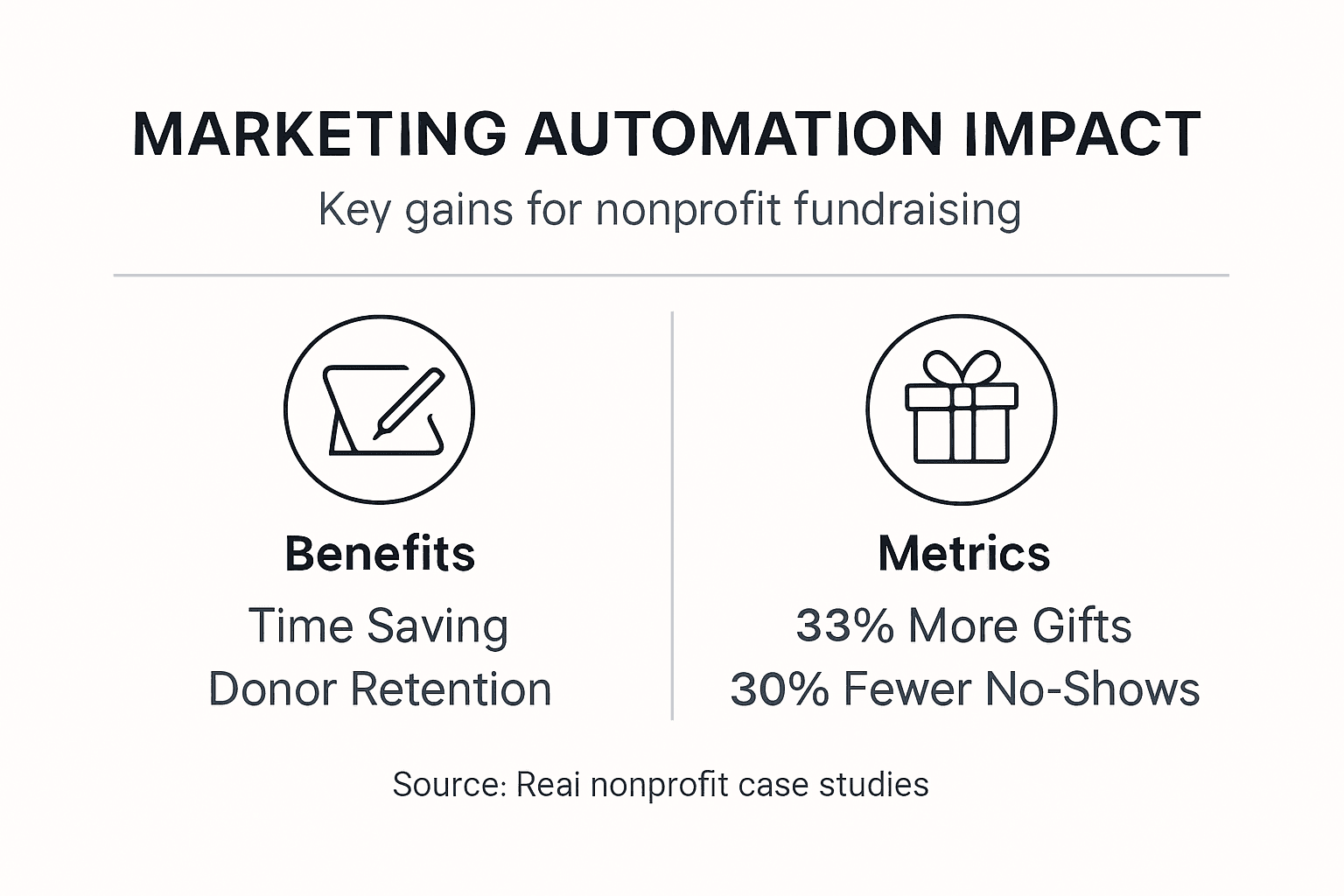
Volunteer coordination becomes dramatically more efficient. Automated reminders, schedules, and follow-ups reduce administrative burden while improving volunteer experience. Organizations report volunteer no-show rates dropping by 30% when using automated reminder sequences. Better coordination means more reliable program delivery and stronger volunteer relationships.
| Benefit Area | Impact Measurement | Time Frame |
|---|---|---|
| Staff Time Savings | 13 hours per week | Ongoing |
| Fundraising Growth | 20-25% increase | Per campaign |
| Volunteer No-Shows | 30% reduction | Per event |
| Donation Conversion | 33% improvement | With AI personalization |
Pro Tip: Start by automating your highest-impact communications first. Welcome emails for new supporters and thank-you messages after donations deliver immediate relationship-building value with minimal setup. These quick wins build momentum for more complex automation later.
The digital marketing automation benefits for ministries and nonprofits extend beyond metrics to mission impact. When technology handles routine tasks, your team focuses on the human connections and strategic decisions that truly require personal attention. Learn more about time savings with automation and segmented communication benefits to understand the full potential.
Common Misconceptions About Marketing Automation
Several persistent myths prevent nonprofits from embracing automation. Understanding the reality behind these misconceptions helps you make informed decisions.
Myth number one claims automation replaces human connection and makes donor relationships feel robotic. The reality is quite different. Marketing automation enhances personalized engagement by enabling timely, relevant communications based on supporter data, not replacing human connection. Automation handles the logistical work so staff can focus on meaningful personal interactions with major donors, volunteers, and community partners. You're not removing the human element but rather amplifying your capacity for personal attention where it matters most.
Another common belief suggests only large nonprofits with substantial budgets can afford marketing automation platforms. Many platforms offer nonprofit-specific pricing structures, significant discounts, and even free tiers designed specifically for smaller organizations. HubSpot, Mailchimp, and other major providers recognize nonprofits' budget constraints and create accessible entry points. Starting with basic automation doesn't require enterprise-level investment.
Some leaders worry automation means sending generic bulk messages that alienate supporters. This concern actually describes poor automation, not automation itself. Proper segmentation ensures highly personalized appeals based on supporter characteristics and behavior. You can create dozens of audience segments and tailor messaging to each group's interests, giving history, and preferences. The result feels more personal than manual campaigns because you're leveraging data to understand what resonates with each supporter.
Key misconceptions clarified:
- Automation enhances rather than eliminates personal donor relationships
- Affordable and free options exist for nonprofits of all sizes
- Segmentation enables highly targeted, relevant messaging instead of generic blasts
- Implementation complexity varies; you can start simple and expand gradually
- Automation complements rather than replaces human fundraisers and relationship managers
Pro Tip: Balance automation frequency carefully to avoid overwhelming donors. Monitor unsubscribe rates and engagement metrics to find the sweet spot where supporters feel informed without feeling bombarded. Most nonprofits find success with one to two automated touchpoints weekly for engaged supporters.
Review tips to avoid automation pitfalls to sidestep common mistakes. Additional context on clarifying automation myths helps you see past misconceptions that might be holding your organization back.
Choosing the Right Marketing Automation Platform
Selecting the right platform determines your automation success. Nonprofit-specific features, pricing, and integration capabilities should guide your decision.
Nonprofit pricing makes automation accessible even with limited budgets. Most major platforms offer discounts ranging from 15% to complete free access for qualified 501(c)(3) organizations. These specialized pricing structures recognize budget constraints while providing enterprise-grade capabilities. Always ask about nonprofit programs before committing to standard pricing.
CRM integration stands as the most critical technical requirement. Your automation platform must connect seamlessly with your donor database to leverage supporter data effectively. Without this integration, you're managing duplicate records and missing the behavioral insights that power personalized automation. Platforms that integrate natively with popular nonprofit CRMs like Salesforce or Blackbaud save significant implementation time.
Salesforce Nonprofit Cloud offers robust CRM integration since it combines both functions in one ecosystem. This platform scales from small organizations to large enterprises with complex fundraising operations. The learning curve is steeper, but capabilities are extensive. Major gift tracking, grant management, and volunteer coordination all integrate within the same system.
HubSpot for Nonprofits delivers user-friendly interfaces with strong email automation and free tiers that include substantial functionality. The marketing hub handles email campaigns, landing pages, and social media scheduling. Reporting dashboards provide clear performance insights without requiring technical expertise. This platform suits organizations prioritizing ease of use and quick implementation.
Bloomerang specializes in fundraising automation for small to mid-sized nonprofits. The platform emphasizes donor retention metrics and relationship management alongside campaign automation. Built specifically for nonprofit workflows, Bloomerang requires less configuration than general-purpose marketing platforms.
| Platform | Best For | Starting Price | Key Strength |
|---|---|---|---|
| Salesforce Nonprofit Cloud | Large organizations | $36/user/month | Complete CRM integration |
| HubSpot for Nonprofits | Growing nonprofits | Free tier available | User-friendly interface |
| Bloomerang | Small to mid-sized | $125/month | Donor retention focus |
| Mailchimp Nonprofits | Email-focused orgs | Free up to 500 contacts | Email automation |
Evaluation criteria for your nonprofit:
- Nonprofit pricing or discounts available
- Native integration with your existing CRM and website
- Email automation capabilities including triggers and workflows
- Segmentation and personalization features
- Reporting dashboards for campaign performance
- Volunteer management if needed
- User interface complexity relative to staff technical skills
Use the marketing automation platform checklist to evaluate options systematically. Request demos from multiple vendors and test platforms with real use cases before committing. The right choice depends on your specific needs, existing systems, and team capabilities.
How to Implement Marketing Automation Successfully
Successful implementation requires strategic planning and disciplined execution. Following proven best practices helps you avoid common pitfalls and achieve results faster.
Define clear automation goals aligned with your mission before selecting tools or building workflows. Are you trying to increase recurring donations, improve volunteer retention, or boost event attendance? Specific, measurable objectives guide platform selection and workflow design. Vague goals like "better donor engagement" lack the clarity needed for effective implementation.
Segment your donor and supporter lists by behavior, giving history, and preferences. Create distinct audiences for first-time donors, recurring supporters, lapsed donors, volunteers, and email subscribers. Each segment receives messaging tailored to their relationship with your organization. This segmentation forms the foundation for personalized automation that drives results.
Start with simple workflows rather than complex multi-step campaigns. Welcome emails for new subscribers and thank-you messages after donations deliver immediate value with straightforward setup. These foundational workflows build confidence and demonstrate ROI before you tackle more sophisticated campaigns. Success with simple automation creates organizational buy-in for expansion.
Regular data cleaning prevents misfiring messages and donor fatigue. Schedule quarterly reviews to remove inactive contacts, update contact information, and correct segmentation errors. Poor data quality undermines even the best automation strategy. Maintaining clean lists ensures your messages reach intended recipients with accurate personalization.
Monitor metrics and optimize campaigns continuously based on performance data. Track open rates, click-through rates, conversion rates, and unsubscribe rates for every automated campaign. A/B test subject lines, send times, and message content to identify what resonates with each audience segment. Optimization turns good automation into great automation over time.
Implementation steps in order:
- Define specific automation goals tied to organizational objectives
- Audit existing donor data and clean your database
- Create audience segments based on behavior and characteristics
- Map simple automation workflows starting with welcome and thank-you sequences
- Configure your chosen platform with proper tracking and integrations
- Test workflows thoroughly before launching to full audiences
- Monitor performance metrics weekly and optimize based on results
- Expand to more complex workflows after proving success with foundational campaigns
Pro Tip: Resist the temptation to automate everything immediately. Over-automation damages donor relationships by making communications feel impersonal and relentless. Reserve some touchpoints for genuine personal outreach from staff. Balance is key to maintaining authentic relationships while scaling efficiently.
Explore purpose-driven automation strategies that align with your mission values. Detailed guidance on email marketing automation helps you execute campaigns that convert. Technical details about data hygiene and optimization ensure your implementation stays on track.
Case Studies and Real-World Examples
Real nonprofits achieve measurable results with marketing automation. These examples demonstrate what's possible when you implement strategically.
The Love Quilt Project saved 13 hours weekly after implementing donor communication automation. Those reclaimed hours allowed their small team to focus on expanding their quilting programs and community partnerships instead of manual email management. The time savings alone justified their platform investment within the first month.
Automated volunteer reminders reduced no-shows by 30% across multiple nonprofit implementations. Simple reminder sequences sent 48 hours and 24 hours before scheduled shifts dramatically improved attendance reliability. Better volunteer coordination meant more consistent program delivery and reduced last-minute staffing scrambles.
AI-driven personalization increased donations by 33% for nonprofits using sophisticated segmentation and behavioral targeting. By analyzing donor history, engagement patterns, and giving capacity, these organizations sent appeals timed and tailored for maximum impact. The conversion lift more than covered automation costs and delivered sustainable fundraising growth.
Real-world evidence confirms automation scales impact without sacrificing authenticity:
- Small teams multiply their outreach capacity by 10x or more
- Donor retention improves when supporters receive timely, relevant communications
- Volunteer satisfaction increases with better coordination and communication
- Fundraising efficiency improves as staff focus on major gift cultivation rather than mass appeals
These results aren't limited to large, well-funded organizations. Small nonprofits with annual budgets under $500,000 report similar benefits when they implement thoughtfully. The key is starting strategically and expanding based on proven results.
Read more digital outreach success stories from nonprofits and ministries. Detailed information about the Love Quilt Project case study and AI personalization donation impact provides additional context and implementation insights.
Conclusion: Transforming Nonprofit Outreach with Marketing Automation
Marketing automation acts as a force multiplier for small nonprofit teams. By handling repetitive tasks and enabling personalized communication at scale, automation frees your staff to focus on mission-critical work that requires human judgment and creativity. The 33% boost in donations from AI-powered personalization demonstrates automation's fundraising potential.
Sustainable donor engagement requires consistent, relevant communication that acknowledges each supporter's unique relationship with your organization. Manual approaches can't deliver this personalization across hundreds or thousands of contacts. Automation can, and it does so while saving your team 13 hours or more each week.
The evidence is clear: nonprofits adopting marketing automation achieve measurable improvements in fundraising, volunteer coordination, and operational efficiency. The technology has matured beyond early complexity to become accessible and affordable for organizations of all sizes. Purpose-led, AI-powered tools enable your nonprofit to compete for donor attention while staying true to your mission values.
Now is the time to explore how AI-powered marketing solutions can transform your outreach. The organizations thriving in 2026 are those that embrace technology to amplify their impact. Your mission deserves tools that help you reach more people, raise more funds, and deliver more programs.
Take Your Nonprofit Marketing to the Next Level with MCNM
You've learned how marketing automation transforms nonprofit outreach and fundraising. Implementing these strategies effectively requires expertise in platform selection, workflow design, and ongoing optimization.
MCNM Marketing specializes in AI-powered marketing automation services for nonprofits and ministries. We understand the unique challenges you face: limited budgets, small teams, and the need to maintain authentic donor relationships while scaling impact. Our digital marketing automation services are designed specifically for mission-driven organizations.
We provide expert support for platform selection, implementation, and campaign optimization. Our team helps you build automation workflows that save time, increase donations, and strengthen supporter relationships. Use our proven marketing automation checklist to start your journey, then partner with us to execute successfully.
Ready to multiply your nonprofit's impact? Visit MCNM Marketing to explore how our faith-driven, purpose-led approach can help you achieve your outreach and fundraising goals.
Frequently Asked Questions
What is marketing automation and how does it help nonprofits?
Marketing automation software handles personalized donor communications and repetitive tasks automatically, saving time and boosting fundraising effectiveness. It sends targeted messages based on supporter behavior like donations, event attendance, or email engagement. This drives better engagement by delivering relevant content at the right time rather than generic mass appeals.
Can small nonprofits afford marketing automation platforms?
Many platforms offer nonprofit pricing and free tiers, making automation affordable for small organizations. HubSpot, Mailchimp, and other providers create special programs recognizing nonprofit budget constraints. Small teams can start basic automation with minimal budget and expand capabilities as they demonstrate ROI.
How do nonprofits avoid over-automating and alienating donors?
Use segmentation and personalization to tailor communication frequency and content for each supporter group. Monitor donor responses including open rates, click-through rates, and unsubscribe rates to identify fatigue. Adjust automation frequency and maintain some personal touchpoints from staff to preserve authentic relationships. Following these automation tips maintains donor trust while scaling outreach.
Recommended
- Email Marketing Automation: Boosting Nonprofit Engagement | AI and Digital Marketing Service by MCNM
- The Benefits of Digital Marketing Automation for Ministries and Nonprofits | AI and Digital Marketing Service by MCNM
- 7 Essential Marketing Automation Tips for Nonprofits | AI and Digital Marketing Service by MCNM
- 6-Step Marketing Automation Checklist for Nonprofits | AI and Digital Marketing Service by MCNM