

Managing donor communication can overwhelm even the most dedicated digital marketing manager. For faith-based nonprofits, staying connected with supporters is crucial but time-consuming. Email marketing automation offers a smarter approach by handling repetitive tasks and sending customized messages triggered by donor actions. This article clarifies the essentials of automation, highlighting how it enables consistent, personalized outreach and gives your team more time for strategic work. Bold a key concept: "personalized communication experiences" to emphasize its value.
Table of Contents
- Defining Email Marketing Automation Essentials
- Types of Email Automation for Nonprofits
- How Automation Works in Email Campaigns
- Key Benefits for Nonprofit Donor Outreach
- Common Challenges and Ethical Considerations
Key Takeaways
| Point | Details |
|---|---|
| Email Marketing Automation Enhances Efficiency | Automating tasks reduces manual workload, allowing teams to focus on strategic donor engagement instead of repetitive emailing. |
| Personalization Increases Donor Connection | Tailored messages based on donor behavior and interests foster stronger relationships and improve engagement rates. |
| Automation Supports Donor Retention | Consistent, relevant communication prevents supporters from feeling forgotten, enhancing long-term commitment and increasing donations. |
| Segmentation Drives Targeted Messaging | Grouping contacts based on behaviors and preferences boosts campaign effectiveness and ensures messages resonate with specific audiences. |
Defining Email Marketing Automation Essentials
Email marketing automation transforms how nonprofits communicate with donors, volunteers, and community members. Rather than sending individual emails manually, automation systems trigger personalized messages based on specific donor actions or behaviors, reducing your team's workload while maintaining consistent engagement.
At its core, nonprofit marketing automation is a technological framework designed to automate repetitive marketing tasks and communication workflows. Your team focuses on strategy while the system handles timing, personalization, and delivery.
Understanding the Core Components
Automation workflows form the backbone of your email program. These are pre-designed sequences that activate automatically when a specific action occurs:
- Welcome series that greets new donors immediately after their first gift
- Thank you flows acknowledging donations with impact updates
- Re-engagement campaigns targeting inactive supporters
- Donor milestone messages celebrating birthdays or anniversary dates
- Event-triggered notifications responding to volunteer sign-ups or registrations
Email marketing automation enables nonprofits to build long-term supporter relationships through timely, relevant messaging aligned with your organizational goals. Rather than sending generic broadcasts, you deliver exactly what each person needs at exactly the right moment.
How Automation Serves Your Mission
Automation handles administrative tasks that consume hours each week. Your development team no longer spends time manually sending thank you emails or reminder messages. Instead, they craft compelling campaigns that reinforce your mission and deepen donor commitment.
Personalization remains central to automation's power. Instead of one-size-fits-all messaging, donors receive content matched to their interests, giving history, and engagement level. A monthly supporter receives different messages than a first-time donor.
Data analytics drive these personalization decisions. Modern automation platforms track opens, clicks, and engagement patterns, revealing which messages resonate most with different donor segments.
Automation doesn't replace relationships—it protects them by ensuring no donor falls through the cracks during busy seasons.
Why Nonprofits Need This Now
Your donors expect responsive, timely communication. When someone makes a gift at 2 a.m., an instant automated thank you confirms their decision matters. When a volunteer expresses interest, an immediate welcome message keeps momentum alive.
Automation also improves donor retention. Consistent, relevant engagement prevents supporters from feeling forgotten between annual appeals. Regular impact updates show how gifts create change, strengthening long-term commitment.
Pro tip: Start with one simple automation workflow—like a welcome series for new donors—before building more complex sequences. Small wins build confidence and demonstrate ROI to your board.
Types of Email Automation for Nonprofits
Different automation types serve different purposes in your nonprofit's donor journey. Each workflow addresses a specific moment when supporters need to hear from you, turning one-time interactions into lasting relationships.
Welcome and Onboarding Sequences
Welcome emails activate immediately after someone joins your mailing list or makes their first gift. These set the tone for your relationship and introduce your mission's impact in compelling ways.
Onboarding sequences typically include:
- Initial welcome message within hours of signup
- Organization mission overview and values alignment
- How donors' contributions create tangible change
- Invitation to take next action (volunteer, attend event, give again)
These sequences convert new subscribers into engaged supporters by providing immediate value and clarity about your work.
Here's a quick comparison of popular email automation workflow types for nonprofits:
| Workflow Type | Typical Trigger | Primary Goal | Long-Term Impact |
|---|---|---|---|
| Welcome Series | New donor signup | Build rapport quickly | Higher initial engagement |
| Lead Nurturing | Interest shown, no donation | Educate and build trust | Increased donation conversions |
| Thank You Flows | Donation received | Express gratitude personally | Enhanced donor loyalty |
| Impact Updates | Scheduled interval | Share progress and impact | Improved donor retention |
| Re-engagement | Inactivity detected | Rekindle supporter interest | Reactivated relationships |
Lead Nurturing and Donor Cultivation
Lead nurturing sequences introduce your mission gradually to prospects who aren't yet ready to donate. Rather than asking for money immediately, you build familiarity and trust through storytelling and impact evidence.
Nurture campaigns typically span 4-8 weeks and include:
- Donor education about your cause
- Success stories showcasing real change
- Impact metrics demonstrating effectiveness
- Gradually increasing donation requests as trust builds
This approach respects donors' decision-making timeline while keeping your mission top-of-mind.
Thank You and Recognition Flows
Automated thank you sequences celebrate donations and reinforce supporter value. These aren't generic receipts—they're personalized expressions of gratitude that deepen emotional connection.
Effective thank you flows include:
- Immediate acknowledgment of the gift
- Specific impact the donation enables
- Recognition of the donor's generosity
- Invitation to stay connected through updates
Donors who receive personalized thank yous give again 38% more often than those receiving generic receipts.
Impact Updates and Re-engagement
Impact update campaigns maintain ongoing engagement between fundraising pushes. These share progress, celebrate milestones, and remind supporters their gifts matter.
Re-engagement campaigns target inactive donors by:
- Acknowledging their past support
- Sharing recent organizational achievements
- Inviting them to reconnect with fresh ways to engage
- Offering exclusive previews or opportunities
Event promotion automation also drives attendance by sending invitations, reminders, and post-event follow-ups on schedule.
Pro tip: Map your donor lifecycle first—from awareness to advocacy—then build one automation workflow for each stage, testing response rates before scaling to more complex sequences.
How Automation Works in Email Campaigns
Automation operates through a simple but powerful principle: set rules once, let software execute them repeatedly. Your team defines what happens when a specific action occurs, and the system delivers consistent results without manual intervention.

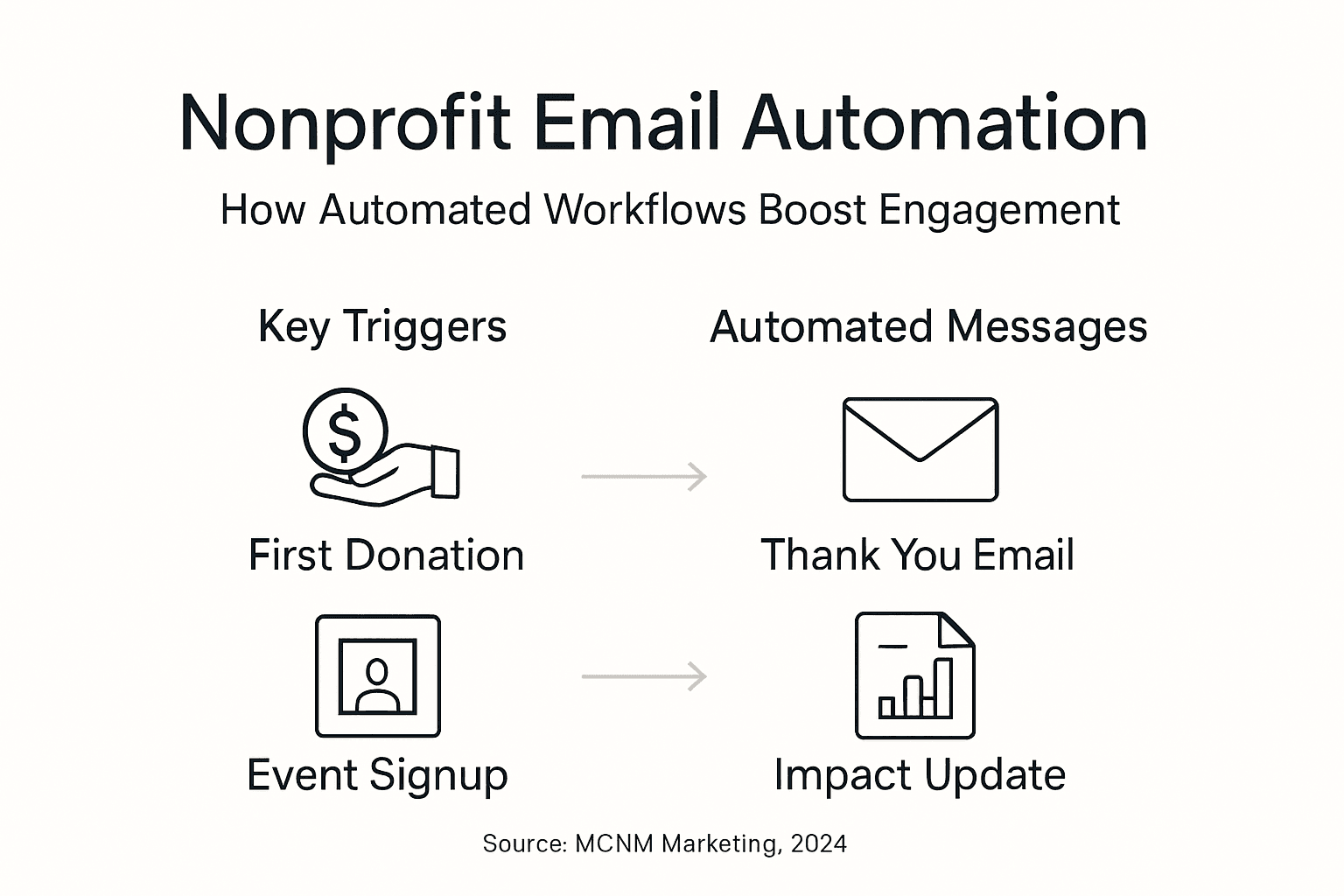
The foundation rests on triggers and actions. A trigger is the event that starts the sequence—someone donates, opens an email, clicks a link, or signs up for your list. Once triggered, the automation executes predetermined actions like sending an email, adding tags to a contact, or waiting a set number of days before the next message.
Understanding Triggers and Rules
Marketing automation operates through workflows triggered by specific user actions such as signing up, clicking links, or making donations. Your nonprofit defines the conditions, and the platform handles execution automatically.
Common triggers include:
- New signup or email list subscription
- Donation received at any amount
- Event registration or attendance
- Email opened or link clicked
- Birthday or anniversary date reached
- Volunteer application submitted
- Form completion on your website
Each trigger can activate multiple automated actions, creating sophisticated multi-step journeys without extra work.
Segmentation Drives Personalization
Segmentation allows you to group contacts based on behavior, interests, or giving history. Rather than sending identical messages to everyone, automation delivers targeted content to specific audiences.
Segmentation categories include:
- Donor level (monthly supporter, major donor, first-time giver)
- Engagement type (email opens, event attendee, volunteer)
- Cause interest (youth programs, disaster relief, community development)
- Communication preference (frequency, format, topics)
Personalized messages perform dramatically better because they speak directly to what each supporter cares about.
Segmented email campaigns generate 14% higher open rates and 100% higher click-through rates than unsegmented broadcasts.
The Workflow in Action
Here's how a real automation flows. Someone makes their first donation. The system immediately sends a thank you email. Three days later, it sends impact information. One week after donation, it invites them to a volunteer opportunity aligned with their interests. Each message arrives automatically, triggered by the original donation and timed perfectly for maximum relevance.
Your team never manually sends these emails. The automation runs constantly, handling thousands of contacts simultaneously while your staff focuses on strategy, storytelling, and relationship-deepening work.
Pro tip: Start by mapping one simple workflow—like a 3-email welcome series for new donors—then monitor opens and clicks to refine messaging before building more complex automation sequences.
Key Benefits for Nonprofit Donor Outreach
Email automation transforms donor relationships by delivering the right message at the right moment. Rather than hoping your message gets noticed, automation ensures consistent, personalized communication that strengthens bonds and drives action.
Building Stronger Donor Relationships
Timely, personalized communication strengthens relationships and fosters engagement and loyalty among your supporters. When donors receive messages tailored to their interests and giving history, they feel valued as individuals, not just transaction sources.
Automation creates relationship depth by:
- Acknowledging donors within hours of their gift
- Sharing impact stories relevant to their cause interests
- Recognizing milestones like donation anniversaries
- Inviting personalized engagement opportunities
- Maintaining consistent contact without overwhelming supporters
These touchpoints transform transactional giving into genuine partnership with your mission.
Freeing Your Team for Strategic Work
Automation increases efficiency by handling repetitive tasks that consume staff time. Your team stops spending hours on manual email sending and starts focusing on relationship-building strategy, compelling storytelling, and major donor cultivation.
Time savings include:
- No more manual thank you email writing
- Eliminated reminder message scheduling
- Reduced data entry and list management
- Fewer hours monitoring when to send follow-ups
- Less administrative overhead overall
These hours redirect toward high-impact work that only humans can do—authentic connection and strategic planning.
This table summarizes the business benefits of email marketing automation for nonprofit teams:
| Automation Benefit | Description | Impact on Nonprofits |
|---|---|---|
| Time Savings | Reduces manual outreach tasks | Frees team for strategic work |
| Personalization | Content tailored for each donor | Strengthens donor relationships |
| Increased Retention | Supports ongoing, relevant engagement | Boosts donor lifetime value |
| Precision Targeting | Sends messages to segmented groups | Improves campaign effectiveness |
Increasing Donor Retention and Giving
Automating email communications allows nonprofits to cultivate stronger donor relationships and boost fundraising results. Regular, relevant engagement prevents the common problem of supporter fatigue or abandonment.
Automation improves retention metrics by:
- Keeping your mission top-of-mind between campaigns
- Celebrating donor impact through regular updates
- Inviting participation in multiple ways beyond giving
- Recognizing supporter loyalty at key moments
- Creating pathways for deepening involvement
Donors who receive regular automated engagement give 167% more over their lifetime compared to those receiving sporadic communication.
Targeting the Right Supporters
Audience segmentation allows precision messaging that resonates with different donor groups. Rather than one generic appeal, you send tailored messages based on demographics, interests, and engagement history.
Segmentation reveals opportunities to:
- Highlight programs matching each donor's passion
- Adjust communication frequency by preference
- Time asks based on giving capacity and readiness
- Invite volunteering aligned with individual skills
- Share impact in formats supporters prefer
When messaging aligns with what donors actually care about, response rates and commitment increase dramatically.
Pro tip: Identify your three most valuable donor segments first, then build one automation sequence for each segment before scaling to additional audiences.
Common Challenges and Ethical Considerations
Automation is powerful, but it demands responsibility. The same tools that deepen donor relationships can damage trust if misused. Your nonprofit must navigate technical challenges while maintaining ethical standards that honor donor consent and organizational values.
Avoiding Donor Fatigue and Alienation
Over-communication kills engagement. When donors receive too many automated messages, they feel bombarded rather than valued. The balance between staying top-of-mind and respecting inbox space determines whether automation strengthens or weakens relationships.
Common fatigue triggers include:
- Multiple messages weekly from the same organization
- Irrelevant content sent to all segments identically
- Automated sequences that don't account for recent donor actions
- Failing to respect unsubscribe preferences immediately
- Sending appeals too frequently without impact stories
Quality trumps quantity. One meaningful message per month outperforms four generic ones.
Managing Data Privacy and Donor Trust
Balancing automation with personalized engagement requires transparent consent management and protecting donor information. Donors must understand what data you collect, how you use it, and have clear options to control their preferences.
Essential privacy practices include:
- Obtaining explicit consent before adding donors to lists
- Providing easy unsubscribe options in every message
- Securing donor data with industry-standard encryption
- Following GDPR, CCPA, and relevant regulations
- Regularly auditing who has access to donor information
- Being transparent about how segmentation works
Donors give generously when they trust you with their information.
Ensuring Messaging Aligns with Values
Automation can inadvertently contradict your mission if messages aren't carefully crafted. A thank you email that sounds impersonal undermines your authenticity. Appeals timed poorly can feel tone-deaf to current events.
Ethical marketing requires ensuring messaging aligns with organizational values to maintain donor trust and long-term engagement. Your team should review automation messages quarterly to ensure they reflect your current mission priorities and respond appropriately to what's happening in your community.
The most sophisticated automation still requires human oversight to ensure every message represents your organization's authentic voice and values.
Technical Challenges and Solutions
Integration complexity can overwhelm small teams. Your email platform must connect with your donor database, website forms, and event registration systems. When these systems don't communicate, data gets duplicated or lost.
Common technical issues:
- Incomplete data syncing between platforms
- Duplicate contact records creating confused histories
- List segmentation logic that excludes intended recipients
- Template formatting problems across email clients
- Bounce rate increases from poor list hygiene
Start simple with basic automation before adding integrations. Ensure your team understands the platform fully before scaling complexity.
Pro tip: Audit your automation workflows monthly by reviewing 10-15 actual donor journeys to catch unintended messages, missed touches, or irrelevant content before they damage relationships.
Elevate Your Nonprofit’s Impact with Expert Email Marketing Automation
Maximizing donor engagement while reducing manual workload is a common challenge shared by many nonprofits. This article highlights how effective email marketing automation builds meaningful relationships through personalized workflows like welcome series, thank you flows, and impact updates. However, implementing these sophisticated systems can feel overwhelming without technical expertise and strategic guidance.
At MCNM Marketing, we specialize in faith-driven digital solutions that empower nonprofits to harness AI-powered automation tailored to your mission. Our services include seamless marketing automation integration, WordPress website development, and ongoing support designed to amplify engagement and boost donations. Let us handle the complex setup so your team can focus on storytelling and relationship building that truly moves your cause forward.
Ready to transform your donor outreach with purpose-led, scalable automation? Visit MCNM Marketing today to learn how our custom solutions can create consistent, personalized connections with your supporters. Discover the relief of streamlined communication and the joy of deeper donor loyalty by partnering with experts who understand your nonprofit’s unique needs.
Frequently Asked Questions
What is email marketing automation for nonprofits?
Email marketing automation for nonprofits is a technological framework that automates repetitive marketing tasks and communication workflows. It enables nonprofits to trigger personalized messages based on specific donor actions or behaviors, streamlining communication while enhancing engagement.
How can automation improve donor engagement?
Automation improves donor engagement by ensuring timely, relevant, and personalized communication. Automated workflows send targeted messages based on donor interactions, which helps maintain relationships and keeps supporters informed and involved with your organization's mission.
What types of email automation workflows are beneficial for nonprofits?
Beneficial email automation workflows for nonprofits include welcome and onboarding sequences for new donors, lead nurturing campaigns to educate prospects, thank you flows to express gratitude, impact updates to keep supporters informed, and re-engagement campaigns to reconnect with inactive donors.
How do triggers and actions work in email automation?
In email automation, triggers are specific events that initiate a sequence, such as a donation or email sign-up. Once triggered, the automation system executes predetermined actions, like sending an email or updating donor information. This ensures consistent communication without manual intervention.
Recommended
- 6-Step Marketing Automation Checklist for Nonprofits | AI and Digital Marketing Service by MCNM
- Why Email Marketing Matters for Nonprofits | AI and Digital Marketing Service by MCNM
- 7 Essential Marketing Automation Tips for Nonprofits | AI and Digital Marketing Service by MCNM
- The Benefits of Digital Marketing Automation for Ministries and Nonprofits | AI and Digital Marketing Service by MCNM
- Percy Cares – Percy Loves