

Defining a clear mission for your nonprofit’s digital content can feel like trying to find the right direction in a crowded space. For many faith-based organizations, every message must connect deeply and highlight purpose. With the right strategies, you can transform outreach into authentic relationships that encourage action and inspire donations. This approach uses your mission statement as a guide for crafting content that truly reflects your goals while making the most of AI-supported efficiency and creativity.
Table of Contents
- Step 1: Define mission-driven content goals
- Step 2: Research audience needs and faith-based topics
- Step 3: Develop an AI-supported content calendar
- Step 4: Produce purpose-led content across channels
- Step 5: Optimize and review content performance
Quick Summary
| Main Insight | Explanation |
|---|---|
| 1. Define mission-driven content goals | Clear objectives ensure all content reflects nonprofit's core values and resonates with supporters effectively. |
| 2. Research audience needs thoroughly | Understanding audience motivations transforms content into targeted, engaging communication that meets community expectations. |
| 3. Utilize AI for content calendar | AI tools streamline scheduling and enhance content planning, improving efficiency while maintaining mission authenticity. |
| 4. Produce purpose-led content | Multi-channel content that aligns with nonprofit values fosters deeper connections and encourages audience engagement. |
| 5. Optimize content performance regularly | Continuous evaluation of content effectiveness leads to actionable insights that refine strategies and foster organizational growth. |
Step 1: Define mission-driven content goals
Defining mission-driven content goals helps nonprofits create purposeful digital strategies that amplify their core purpose and impact. By establishing clear, actionable objectives, organizations can develop targeted content that resonates with supporters and drives meaningful engagement.
To craft effective mission-driven content goals, start by revisiting your organization's fundamental mission. Nonprofit mission statements guide strategy and provide a critical framework for all communication efforts. Break down your mission into specific, measurable content objectives:
- Identify your core organizational values
- Translate mission statements into content themes
- Determine specific audience segments
- Establish quantifiable engagement metrics
Successful mission-driven content requires aligning digital communication with your nonprofit's deeper purpose. This means every piece of content should:
- Reflect your organization's core values
- Address specific stakeholder needs
- Demonstrate tangible impact
- Inspire action or support
Content that authentically represents your mission becomes a powerful tool for connecting with supporters and driving meaningful change.
Pro tip: Conduct periodic content audits to ensure your digital materials consistently reflect your nonprofit's mission and evolve with your organization's growth.
Step 2: Research audience needs and faith-based topics
Researching audience needs and faith-based topics is crucial for creating meaningful digital content that resonates with your nonprofit's community. This step involves understanding the unique characteristics, challenges, and motivations of your specific faith-based audience.
Faith-based organizations deeply influence community dynamics by providing critical social services and building trust. To effectively research audience needs, consider these strategic approaches:
- Conduct surveys within your faith community
- Review existing demographic research
- Analyze engagement metrics from previous content
- Interview community leaders and stakeholders
Your research should focus on understanding several key dimensions:
- Spiritual interests and theological perspectives
- Social service needs
- Communication preferences
- Digital engagement habits
Authentic audience research transforms content from generic messaging to targeted, meaningful communication that truly serves your community.
Pro tip: Use anonymous focus groups and digital analytics to gather nuanced insights about your faith-based audience's content preferences and needs without compromising individual privacy.

Step 3: Develop an AI-supported content calendar
Developing an AI-supported content calendar empowers nonprofits to streamline their digital communication strategy with unprecedented efficiency and precision. This strategic approach combines technological innovation with mission-driven creativity to generate compelling content that resonates with your audience.
AI tools are transforming nonprofit content planning by automating repetitive tasks and generating optimized scheduling recommendations. To create an effective AI-supported content calendar, follow these strategic steps:
- Select an AI content planning tool
- Input your organization's mission and key messaging
- Define content themes and audience segments
- Set publication frequency and channel preferences
Your AI-supported content calendar development should include:
- Analyzing historical content performance
- Generating topic recommendations
- Identifying optimal posting times
- Creating draft content outlines
Successful AI content calendars balance technological efficiency with human creativity and strategic oversight.
Pro tip: Always review and personalize AI-generated content suggestions to ensure they authentically represent your nonprofit's unique voice and mission.
This table compares manual vs. AI-supported content calendar management:
| Approach | Process Complexity | Scheduling Precision | Time Investment |
|---|---|---|---|
| Manual | High—requires hands-on tracking | Often inconsistent | Considerable ongoing effort |
| AI-Supported | Automated recommendations | Consistent and optimized | Reduced, with AI handling tasks |
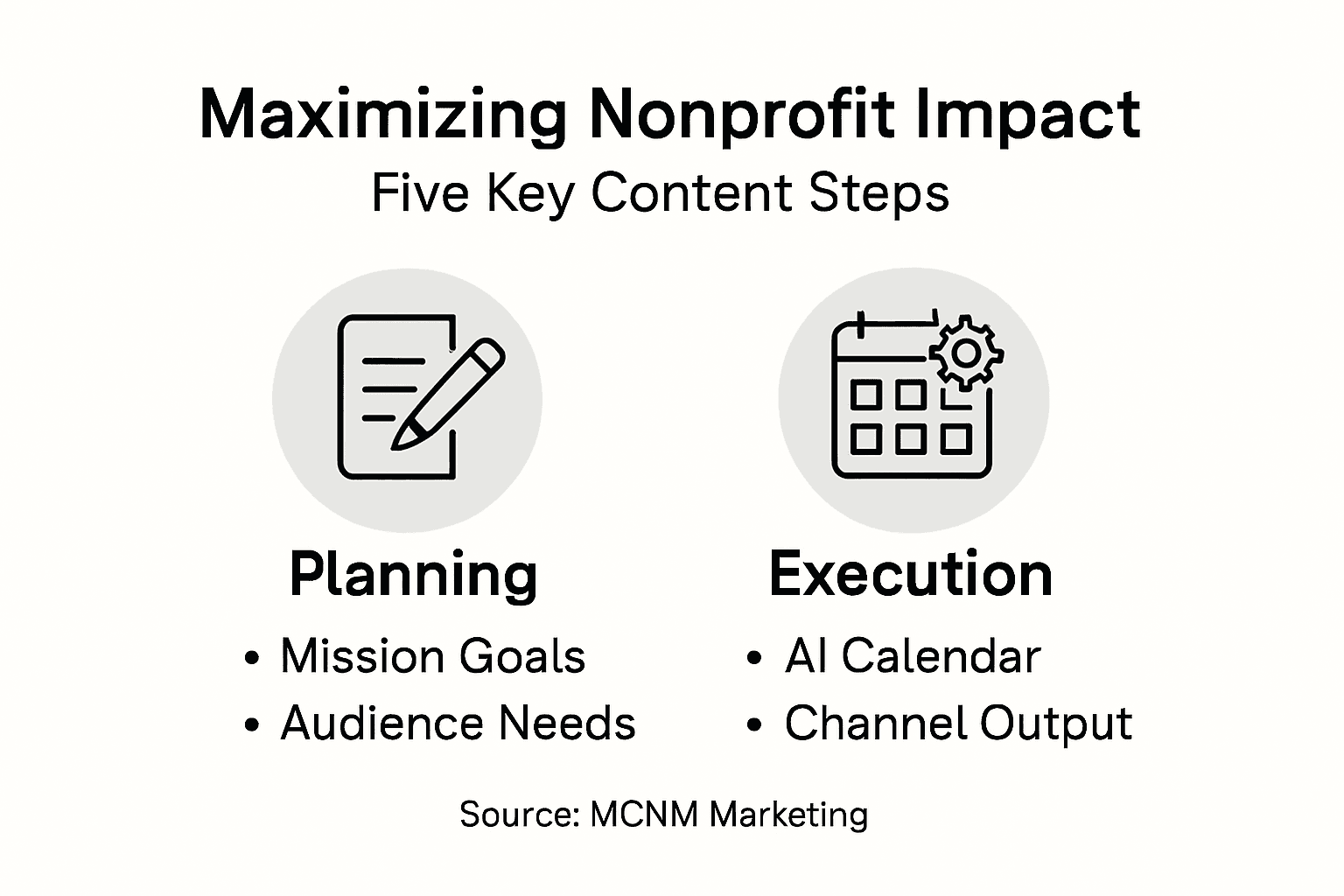
Step 4: Produce purpose-led content across channels
Producing purpose-led content requires a strategic approach that aligns your nonprofit's core mission with compelling digital communication across multiple platforms. This step transforms your organization's values into engaging narratives that inspire action and build meaningful connections with your audience.
Purpose-led content strategy embeds mission in every message by ensuring authenticity and consistent communication. To effectively create purpose-driven content across channels, consider these key strategies:
- Develop a unified messaging framework
- Adapt content for different platform requirements
- Maintain consistent brand voice and values
- Create multimedia content that tells your mission story
Your purpose-led content production should focus on:
- Crafting narratives that highlight social impact
- Using diverse content formats
- Personalizing messaging for specific audience segments
- Measuring engagement and mission alignment
Purpose-led content transforms communication from transactional interactions to meaningful conversations that drive societal change.
Pro tip: Conduct regular content audits to ensure each piece of communication genuinely reflects your nonprofit's core values and advances your mission.
Step 5: Optimize and review content performance
Optimizing and reviewing content performance is essential for nonprofits to ensure their digital communication strategies effectively advance their mission. This critical step transforms data into actionable insights that drive continuous improvement and meaningful engagement.
Measuring nonprofit content effectiveness requires systematic evaluation by establishing clear success metrics and analyzing performance data. To effectively optimize your content strategy, implement these key evaluation techniques:
- Track engagement across different platforms
- Compare performance against predefined goals
- Analyze audience interaction and feedback
- Identify content themes with highest impact
Your content performance review should encompass:
- Quantitative metrics like views and shares
- Qualitative feedback from stakeholders
- Alignment with organizational mission
- Conversion and action rates
Strategic content optimization transforms data points into powerful narratives of organizational impact and growth.
Pro tip: Develop a standardized quarterly review process that combines data analytics with stakeholder insights to continuously refine your content strategy.
Here's a summary of how each step advances nonprofit digital strategy:
| Step | Primary Focus | Key Outcome | Unique Value |
|---|---|---|---|
| Define Content Goals | Mission alignment | Clear objectives | Drives purposeful messages |
| Research Audience Needs | Community insight | Relevant topics | Ensures authentic engagement |
| AI Content Calendar | Efficient planning | Optimized schedules | Balances tech and creativity |
| Purpose-Led Content | Multi-channel impact | Engaging narratives | Builds stronger connections |
| Content Optimization | Continuous improvement | Actionable insights | Refines strategy for growth |
Elevate Your Nonprofit’s Mission with Purpose-Driven Digital Solutions
Navigating the challenges of mission alignment and audience engagement can feel overwhelming. This guide highlights the need for clear mission-driven content goals, authentic audience research, AI-supported content calendars, and continuous optimization. You want to create purposeful content that truly reflects your values and inspires action. But balancing strategic digital communication with technical demands is not easy.
At MCNM Marketing, we specialize in empowering faith-based nonprofits and ministries to overcome these exact pain points. Our AI-powered marketing automation and website development services help you streamline your content planning and amplify your impact. With customized WordPress solutions designed for robust outreach, SEO, and digital analytics, we bring your mission to life with efficiency and authenticity.
Unlock the full potential of your digital strategy by combining your passion for purpose-led content with advanced AI tools tailored just for you at MCNM Marketing. Discover how our expert team supports your content optimization, multi-channel storytelling, and seamless automation to grow your digital presence and deepen community engagement.
Ready to transform your nonprofit’s digital outreach? Explore our comprehensive services now.
Faith-Driven AI Solutions
Explore Purpose-Led Website Strategies
Discover Marketing Automation That Works
Take the next step to maximize your nonprofit’s impact through strategic content and technology. Visit MCNM Marketing today to get started on a tailored plan that aligns your mission with measurable digital growth.
Frequently Asked Questions
How can I define mission-driven content goals for my nonprofit?
To define mission-driven content goals, start by revisiting your nonprofit's core mission and values. Break this down into specific, measurable objectives that align with your purpose, such as increasing supporter engagement by 20% within six months.
What methods can I use to research audience needs for faith-based topics?
To research audience needs, consider conducting surveys within your faith community and reviewing existing demographic studies. Engage with community leaders to gain qualitative insights, which can enhance your content's relevance and resonance.
How do I develop an AI-supported content calendar?
To develop an AI-supported content calendar, choose an AI content planning tool and input your mission along with key messaging. Ensure to set publication frequency and themes to streamline your content strategy, ultimately reducing planning time by about 30%.
What should I focus on when producing purpose-led content?
When producing purpose-led content, create a unified messaging framework that aligns with your core values. Ensure that your narratives are tailored for various platforms, using multimedia formats to engage your audience effectively.
How can I optimize and review content performance for my nonprofit?
To optimize and review content performance, establish clear success metrics to track engagement, and compare results against your predefined goals. Implement a standardized quarterly review process to refine your content strategy based on quantitative and qualitative feedback.