

Most nonprofits have embraced AI automation tools, but a striking gap persists between adoption and true transformation. While 92% of nonprofits use AI, only 7% achieve major mission impact. This isn't about technology failure; it's about strategy. Too many organizations remain stuck on an efficiency plateau, achieving incremental gains while missing the transformative power of 30% more donor engagement with automation. You can break through this plateau by shifting from tactical speed gains to strategic mission evolution.
Table of Contents
- The Efficiency Plateau vs Transformative Automation
- How Automation Tools Enhance Nonprofit Digital Marketing and Fundraising
- Challenges and Misconceptions in Adopting Automation Tools
- Framework for Choosing and Implementing Automation Tools
- Case Studies: Faith-Based Organizations Successfully Using Automation
- Conclusion: Leading the Mission with AI-Powered Automation
- Explore AI-Powered Solutions Tailored for Nonprofits
- Frequently Asked Questions about Automation Tools in Nonprofits
Key Takeaways
| Point | Details |
|---|---|
| Efficiency Plateau Reality | 79% of nonprofits report only small to moderate improvements from AI tools, stuck in incremental gains. |
| Transformative Automation | True impact comes from restructuring workflows and strategy, not just faster task completion. |
| Donor Engagement Power | AI-driven personalization and predictive analytics significantly boost fundraising and retention rates. |
| Skills and Governance Barriers | Digital capability gaps and lack of outcome frameworks prevent most organizations from maximizing AI benefits. |
| Strategic Framework Essential | Systematic evaluation of mission alignment, capacity, and scalability guides successful tool selection. |
The Efficiency Plateau vs Transformative Automation
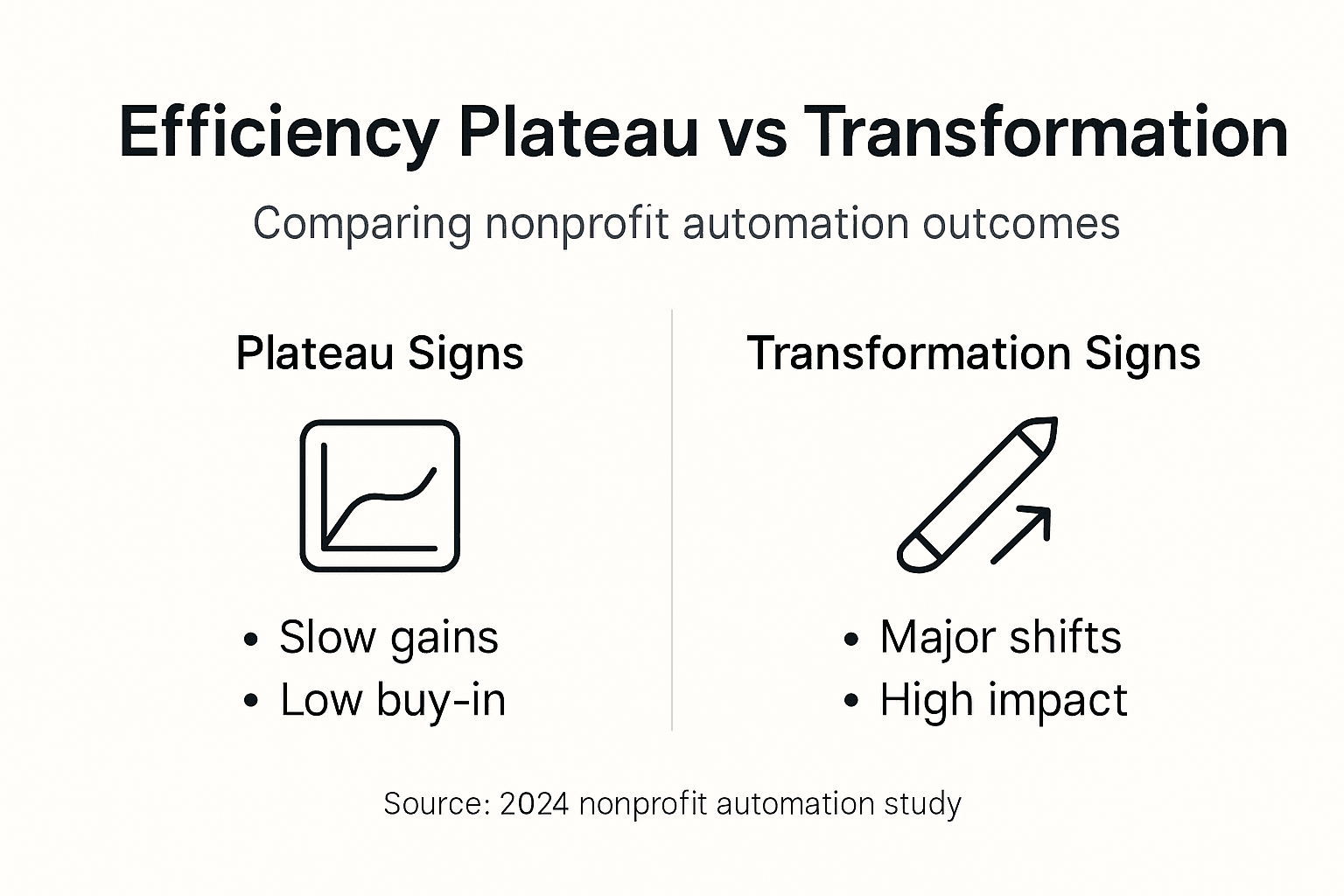
The efficiency plateau represents a critical trap where organizations deploy AI tools to speed up existing processes without fundamentally rethinking how work gets done. You're essentially running the same playbook faster. 79% of nonprofits experience only small to moderate improvements because they never move beyond this stage.
Transformative automation operates differently. It challenges your core workflows, governance structures, and impact measurement systems. You're not just automating email sends; you're redesigning how donor relationships develop across every touchpoint. This approach requires uncomfortable questions about which processes deserve automation versus elimination or complete redesign.
Common failure points include implementing tools without staff buy-in, skipping the workflow documentation phase, and measuring only time savings rather than mission outcomes. Organizations often purchase expensive platforms but use only 20% of available features because no one mapped capabilities to strategic needs first.
Here's how these approaches compare:
| Aspect | Efficiency Plateau | Transformative Automation |
|---|---|---|
| Focus | Task speed | Workflow redesign |
| Measurement | Time saved | Mission impact metrics |
| Implementation | Tool-first | Strategy-first |
| Staff Role | Task executors | Strategic partners |
| Outcome | Incremental gains | Exponential growth |
Pro Tip: Before selecting any automation tool, spend two weeks documenting your current workflows in excruciating detail. This reveals hidden inefficiencies and transformation opportunities that technology alone cannot solve. Your purpose-driven marketing automation guide can help structure this discovery process.
How Automation Tools Enhance Nonprofit Digital Marketing and Fundraising
AI-powered platforms revolutionize how nonprofits connect with supporters by enabling capabilities that were impossible manually. Content creation, email campaigns, social media management, and ad optimization all benefit from intelligent automation that learns and adapts to audience behavior.
Robotic Process Automation (RPA) tackles the unglamorous but essential operational tasks consuming staff time. Data entry, donor record updates, and routine outreach communications get handled automatically, freeing your team for relationship building and strategic work. This isn't about replacing people; it's about elevating their contributions.

Hyper-personalization and predictive analytics represent the cutting edge of donor engagement. These tools analyze giving patterns, communication preferences, and engagement signals to predict optimal contact timing and message content. The global AI marketing industry expects a $4.4 trillion boost by 2027, reflecting this transformative potential.
Key automation capabilities benefiting nonprofits:
- Dynamic segmentation creating real-time donor groups based on behavior and preferences
- Predictive scoring identifying high-potential donors before they self-identify
- Automated journey mapping guiding supporters from awareness to sustained giving
- Performance analytics revealing which campaigns drive mission impact versus vanity metrics
- Multi-channel orchestration ensuring consistent messaging across email, social, and web platforms
These capabilities directly support your fundraising infrastructure. Content automation for nonprofits enables consistent storytelling across channels while email marketing automation nurtures relationships at scale. The 7 essential marketing automation tips for nonprofits provide actionable starting points for implementation.
Challenges and Misconceptions in Adopting Automation Tools
Several persistent myths undermine successful AI adoption in nonprofit organizations. The biggest misconception treats automation as purely a speed enhancement tool rather than a strategic capability requiring thoughtful integration. Leaders often believe AI will simply accelerate current processes without recognizing the need for workflow redesign.
Another dangerous assumption positions AI as a staff replacement strategy. This framing creates resistance and misses the actual value proposition: augmenting human capabilities for higher-impact work. Your team should spend less time on data entry and more time building donor relationships, not worry about job security.
Digital skills gaps represent major adoption barriers, particularly in smaller faith-based organizations operating with volunteer or part-time staff. Without foundational digital literacy, even user-friendly platforms remain underutilized. This creates a vicious cycle where tools fail to deliver expected results, reinforcing skepticism about technology investments.
Governance and outcome measurement frameworks are frequently overlooked during implementation. Organizations deploy tools without establishing clear success metrics, accountability structures, or data privacy protocols. This oversight leads to scattered adoption, inconsistent usage, and inability to demonstrate ROI to board members or donors.
Common barriers include:
- Inadequate staff training budgets relative to technology investments
- Lack of clear automation ownership across departments
- Resistance to changing comfortable but inefficient workflows
- Absence of data quality standards undermining AI effectiveness
- Unclear communication about automation goals creating staff anxiety
Pro Tip: Allocate at least 30% of your automation budget to staff training and change management. Technology purchases without capability building consistently fail. Your marketing automation checklist includes critical training milestones often missed during rollout.
The selection trap catches many organizations: choosing tools based on features rather than strategic fit. A platform with impressive capabilities matters little if it doesn't align with your specific workflows, technical capacity, or mission priorities.
Framework for Choosing and Implementing Automation Tools
Successful automation adoption follows a systematic evaluation process ensuring alignment between technology capabilities and organizational readiness. This framework prevents costly mismatches and accelerates time to value.
Start with honest assessment:
- Document current workflows identifying repetitive tasks, decision points, and handoff failures
- Evaluate digital maturity across staff, infrastructure, and data management practices
- Define clear success metrics tied to mission outcomes, not just operational efficiency
- Establish governance structures specifying tool ownership, data policies, and decision authority
- Create capability maps showing required skills versus current team competencies
- Set realistic timelines acknowledging learning curves and necessary process adjustments
Your tool selection criteria should balance capability with complexity:
| Evaluation Factor | RPA Tools | AI Marketing Platforms |
|---|---|---|
| Best For | Rule-based repetitive tasks | Predictive personalization and content |
| Technical Skill Required | Low to moderate | Moderate to high |
| Implementation Time | Weeks to months | Months to year |
| Mission Alignment | Operational efficiency | Donor engagement growth |
| Scalability | Limited to defined processes | High with data volume |
| Initial Investment | Lower | Higher |
Implementation requires sequential attention:
- Begin with high-impact, low-complexity processes demonstrating quick wins and building confidence
- Pilot extensively before full deployment, gathering user feedback and refining workflows
- Train staff in waves, creating internal champions who support peers through adoption challenges
- Monitor leading indicators like usage rates and error patterns, not just lagging outcomes
- Iterate based on real-world performance, adjusting both tool configurations and supporting processes
- Scale gradually as competency grows, resisting pressure to automate everything simultaneously
Mission alignment must drive every decision. Ask whether each automation candidate strengthens your core purpose or merely reduces costs. The right tools amplify your unique value proposition; wrong ones create generic experiences disconnecting you from supporters.
Your digital growth strategy should inform tool selection, ensuring technology serves strategy rather than dictating it. The purpose-driven marketing automation guide provides detailed selection criteria aligned with nonprofit mission priorities.
Case Studies: Faith-Based Organizations Successfully Using Automation
Real-world examples demonstrate how strategic automation adoption transforms nonprofit outcomes. One mid-sized ministry implemented donor segmentation AI and saw a 43% increase in recurring giving within eight months. The key was moving beyond demographic groupings to behavioral predictions identifying supporters ready for deeper commitment.
Another faith-based organization serving low-income communities automated their volunteer coordination and saw 60% more consistent engagement. By removing friction from signup, scheduling, and communication processes, they made participation effortless for supporters juggling demanding work schedules.
The grassroots giving opportunity remains largely untapped. Donors giving $200 or less contributed $4 billion with 15% growth, yet only 12% was captured through online fundraising despite 63% of these donors preferring digital giving. Automation bridges this gap by creating frictionless online experiences matching donor preferences.
One youth ministry deployed AI-powered email personalization and increased open rates by 67% and click-throughs by 89%. They segmented based on engagement history, preferred communication frequency, and expressed interests rather than age alone. Each supporter received content aligned with their journey stage and demonstrated preferences.
Key lessons from successful implementations:
- Start with clear mission outcomes, not technology features
- Invest heavily in staff capability building alongside tools
- Measure impact through donor satisfaction and retention, not just operational metrics
- Iterate based on user feedback from both staff and supporters
- Maintain authentic voice and mission focus despite automation scale
- Build data quality practices enabling AI accuracy and personalization
These organizations share a common thread: they viewed automation as strategic enabler rather than cost-cutting tool. Their digital outreach for nonprofits strategies integrated technology with relational ministry rather than replacing human connection.
Conclusion: Leading the Mission with AI-Powered Automation
The efficiency plateau traps most nonprofits in incremental gains when transformative impact awaits strategic adoption. Moving beyond task automation to workflow evolution requires courage to question comfortable processes and invest in both technology and people.
Your organization faces a choice: maintain current operations with minor improvements or embrace automation as a catalyst for mission amplification. The 7% achieving major impact didn't stumble into success; they approached AI strategically with clear governance, capability building, and mission alignment.
Faith-based nonprofits possess unique advantages in this journey. Your purpose-driven foundation provides the values framework guiding ethical AI use. Your community orientation ensures technology serves relationships rather than replacing them. Your mission clarity focuses automation investments on outcomes that matter.
The path forward demands intentional leadership. Assess honestly, implement systematically, and measure what matters. Your supporters deserve the personalized engagement AI enables. Your mission deserves the amplified impact strategic automation delivers. The MCNM blog for nonprofit AI insights offers ongoing guidance as you navigate this transformation.
Explore AI-Powered Solutions Tailored for Nonprofits
MCNM Marketing specializes in helping nonprofits and faith-based organizations move beyond the efficiency plateau to transformative automation. We understand the unique challenges you face: limited budgets, volunteer staff, and the critical need to maintain authentic mission focus while scaling impact.
Our purpose-driven marketing automation guide walks you through strategic implementation aligned with your mission. The 6-step marketing automation checklist provides a practical roadmap from assessment through optimization. We offer WordPress solutions ranging from basic to enterprise grade, paired with AI-driven content automation, email marketing systems, and analytics that measure mission impact, not just metrics. Our faith-driven approach ensures technology serves your purpose, never overshadows it.
Frequently Asked Questions about Automation Tools in Nonprofits
What initial steps should nonprofits take to adopt AI automation effectively?
Start by documenting your current workflows to identify high-impact automation opportunities. Assess your team's digital literacy honestly and budget for training alongside technology. Define clear success metrics tied to mission outcomes before selecting any tools.
How can nonprofits measure the impact of automation tools on fundraising?
Track donor retention rates, recurring giving growth, and average lifetime value rather than just campaign response rates. Monitor engagement quality through metrics like email interaction depth and website behavior patterns. Compare mission outcome achievement before and after automation implementation.
What are common digital skills gaps hindering adoption, and how to address them?
Most organizations lack data management fundamentals, basic analytics interpretation, and workflow design thinking. Address gaps through structured training programs, peer learning groups, and partnerships with digital-focused nonprofits. The 7 essential marketing automation tips for nonprofits includes capability-building resources.
Can small faith-based nonprofits benefit from AI automation with limited resources?
Absolutely. Start with low-cost tools automating high-impact processes like email segmentation or volunteer coordination. Many platforms offer nonprofit discounts or free tiers. Focus on one or two strategic automation wins before expanding.
What misconceptions should nonprofit leaders avoid regarding AI?
Never view AI as staff replacement or assume it works effectively without quality data and clear strategy. Avoid expecting immediate results; transformation takes time and iteration. Don't select tools based solely on features without considering mission alignment and team capacity.
Recommended
- Automate Marketing: 30% More Donor Engagement in 2026 | AI and Digital Marketing Service by MCNM
- Why Use Content Automation for Nonprofits | AI and Digital Marketing Service by MCNM
- Why Use AI in Nonprofits: Boosting Impact and Efficiency | AI and Digital Marketing Service by MCNM
- The Benefits of Digital Marketing Automation for Ministries and Nonprofits | AI and Digital Marketing Service by MCNM